
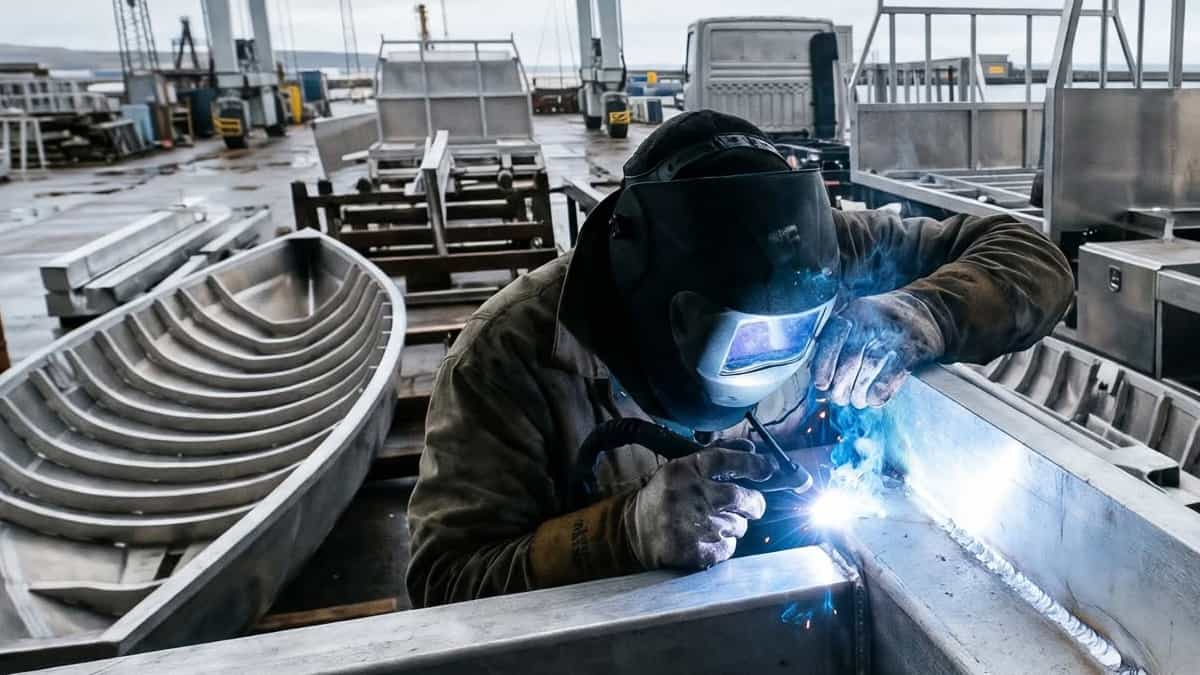
Aluminium 6351 T6 – also known as Aluminum 6351 T6 – is a heat‑treatable aluminium‑magnesium‑silicon alloy belonging to the 6000 series. While the broader 6xxx family is valued for balanced properties, 6351 T6 is specifically recognised for delivering higher strength than 6061 while retaining excellent weldability, good corrosion resistance and moderate extrudability. In the T6 temper – solution heat treated and artificially aged – it achieves minimum tensile strength of 295 MPa and yield strength of 255 MPa, making it a practical structural alloy for marine, defence, transport and general engineering applications where 6061 lacks sufficient strength and 7xxx alloys would introduce unnecessary cost or corrosion complexity.
What is Aluminium 6351 T6?
Aluminium alloy 6351 is a member of the 6000 series (aluminium‑magnesium‑silicon) and is chemically positioned between 6061 and 6082 in terms of strength. Its magnesium and silicon contents (each approximately 0.4–0.8%) form magnesium‑silicide (Mg₂Si) precipitates during artificial ageing, which is the primary strengthening mechanism. The manganese addition (0.4–0.8%) contributes to grain structure control and toughness, while the low copper content keeps the alloy readily weldable and corrosion‑resistant.
The T6 temper is the most widely specified condition for structural use. It involves solution heat treatment followed by artificial ageing to achieve a stable, high‑strength condition with moderate ductility. Aluminium 6351 T6 is commonly supplied as extruded bar, rod, tube and profile, and is widely known under designations such as EN AW‑AlSi1Mg0.5Mn, ISO AlSi1Mg0.5Mn, UNS A96351 and AFNOR A‑SGM0.7.
Key Characteristics at a Glance
- ✓ Density: 2.71 g/cm³
- ✓ Melting point: 554°C
- ✓ Thermal conductivity: 176 W/m·K (T6)
- ✓ Modulus of elasticity: 68.9–69 GPa
- ✓ Minimum tensile strength (T6, <150 mm): 295 MPa
- ✓ Typical tensile strength (T6): 310 MPa (MatWeb, AA typical)
- ✓ Minimum yield strength (T6, <150 mm): 255 MPa
- ✓ Typical yield strength (T6): 283 MPa (MatWeb, AA typical)
- ✓ Elongation (T6): 8% minimum (product standard) to 14% (AA typical)
- ✓ Hardness: 95 HB
- ✓ Electrical conductivity: 46% IACS
Data compiled from BlueScope Distribution, MatWeb and Referans Metal.
Chemical Composition
Aluminium 6351 is a magnesium‑ and silicon‑rich alloy with manganese as a secondary addition. The balanced Mg/Si ratio promotes efficient Mg₂Si precipitation, while the manganese refines grain structure and supports toughness. Unlike 6061, 6351 contains no intentional chromium addition, and its copper limit is tighter, contributing to its good weldability and corrosion behaviour.
| Element | Percentage (%) |
|---|---|
| Aluminium (Al) | 96 – 98.5 |
| Silicon (Si) | 0.70 – 1.30 |
| Magnesium (Mg) | 0.40 – 0.80 |
| Manganese (Mn) | 0.40 – 0.80 |
| Iron (Fe) | ≤ 0.50 |
| Copper (Cu) | ≤ 0.10 |
| Zinc (Zn) | ≤ 0.20 |
| Titanium (Ti) | ≤ 0.20 |
| Others (Each) | ≤ 0.05 |
| Others (Total) | ≤ 0.15 |
Source: BlueScope Distribution / Referans Metal (EN AW‑AlSi1Mg0.5Mn)
The low copper and iron limits help maintain corrosion resistance and weld integrity, while the silicon and magnesium levels are optimised for the T6 strengthening response.
Key Properties of Aluminium 6351 T6
💪 High Strength – Higher than 6061, Close to 6082
Aluminium 6351 T6 delivers higher strength than 6061 T6 and sits just below 6082 T6 in the 6xxx hierarchy. This makes it a useful middle‑ground structural alloy: stronger than general‑purpose 6061, yet more readily extrudable and weldable than some higher‑strength alternatives.
Typical Mechanical Properties (T6 Temper):
| Property | Value |
|---|---|
| Ultimate tensile strength (product standard, <150 mm) | 295 MPa minimum |
| Ultimate tensile strength (AA typical) | 310 MPa |
| Yield strength (product standard, <150 mm) | 255 MPa minimum |
| Yield strength (AA typical) | 283 MPa |
| Elongation | 8% min (standard) / 14% (AA typical) |
| Shear strength | 200 MPa |
| Fatigue strength | 89.6–90 MPa |
| Hardness | 95 HB |
Sources: BlueScope Distribution / MatWeb / Referans Metal
In research settings, optimised T6 treatments have achieved UTS up to 320 MPa and YS up to 270 MPa, with elongation around 12%, confirming the alloy’s response to controlled artificial ageing.
🛡️ Excellent Corrosion Resistance – Marine‑Grade Capability
Aluminium 6351 T6 exhibits excellent corrosion resistance in normal atmospheres and marine environments, owing to the thin, self‑healing aluminium oxide film that forms on its surface. The 6xxx series is widely regarded as a marine‑grade family, and 6351 T6 is specifically used in scuba tanks, boat fittings and offshore structural components. Its corrosion performance is superior to that of copper‑rich 2xxx and zinc‑rich 7xxx alloys in many service environments, making it a practical choice where both strength and long‑term durability are required.
🔧 Excellent Weldability – A Defining Advantage
One of the strongest practical arguments for 6351 T6 is its excellent weldability by all standard methods, including GMAW (MIG) and GTAW (TIG). Recommended filler alloys are 4043 as the primary choice and 5356 as a suitable alternative. The alloy can also be brazed. Because it is heat‑treatable, some strength reduction occurs in the heat‑affected zone after welding, but the welded joint retains good mechanical integrity and corrosion resistance, enabling reliable fabrication of large structural assemblies.
⚙️ Good Machinability and Formability
Machinability of 6351 is rated as good in the T5 and T6 tempers, and the alloy also offers very good formability in appropriate conditions. It can be extruded, forged and rolled, although its extrudability is moderate rather than exceptional – suitable for structural profiles but not for the most complex thin‑wall shapes. For forming operations, softer tempers such as O or T4 are preferred, while T6 is typically specified for finished machined or welded components.
🔥 Heat Treatment – The T6 Temper
The T6 designation indicates that the alloy has been solution heat treated and then artificially aged to achieve a stable, high‑strength condition. This is the most common temper for structural extrusions, bar and tube. The T6 treatment produces a fine, well‑dispersed precipitate distribution that maximises strength, albeit with lower elongation than softer tempers. Other available tempers include O (annealed), T4 (solution treated and naturally aged), T5 (cooled from hot working and artificially aged) and T651 (stress‑relieved by stretching) .
Applications of Aluminium 6351 T6
Aluminium 6351 T6 is a structural workhorse whose combination of higher‑than‑6061 strength, excellent weldability and marine‑grade corrosion resistance makes it suitable for demanding fabricated structures across multiple industries.
⚓ Marine and Offshore – A Core Application
6351 T6 is widely used in marine structures, boat hulls and fittings, scuba tanks and offshore components where resistance to seawater corrosion and weldability are essential. Its ability to be welded into large assemblies without severe loss of performance makes it practical for shipyards and boatbuilders.
🚛 Transport and Structural Engineering
The alloy is used in truck bodies, recreational trailers, automotive componentry, rail structures and bridge and civil structural supports. Its higher strength than 6061 allows weight savings or increased load capacity in these applications without moving to a less weldable or more corrosion‑sensitive alloy family.
🛡️ Defence and General Engineering
Defence applications include strong alloy plates and structural components, while general engineering uses include food processing equipment, pipes and tubes, and high‑stress mechanical parts. The alloy is also used in aircraft fuel tank brackets and non‑primary aerospace structures where its strength‑to‑weight ratio and corrosion resistance are advantageous.
🏗️ Extruded Profiles and Tubing
Because 6351 T6 is commonly supplied as extruded bar, rod, tube and profile, it is frequently specified for structural framing, handrails, support members and general extruded sections in construction and industrial equipment.
Fabrication & Workability – Quick Guide
| Aspect | Recommendation |
|---|---|
| Welding | Excellent – MIG and TIG suitable; use 4043 filler (primary) or 5356 (alternative) |
| Machining | Good in T5 and T6 tempers; use appropriate cutting tools and lubrication |
| Forming | Very good in softer tempers (O, T4); limited in T6 |
| Extrusion | Moderate – suitable for structural profiles, not ultra‑thin complex shapes |
| Heat treatment | Solution treat and artificially age to T6; T651 available for stress‑relieved stock |
| Corrosion protection | Often used unpainted in marine atmospheres; anodising possible but not as critical as for 2xxx/7xxx alloys |
| Joining (non‑weld) | Riveting and bolting are viable; adhesive bonding can supplement welded assemblies |
WHY CHOOSE ALUMINIUM 6351 T6?
- ✓ Higher strength than 6061 T6 – 295 MPa minimum UTS vs. 260 MPa for 6061 T6
- ✓ Excellent weldability – MIG, TIG and brazing all suitable; weld joints retain good integrity
- ✓ Excellent corrosion resistance – suitable for marine and offshore service
- ✓ Good machinability in T5 and T6 tempers
- ✓ Very good formability in softer tempers
- ✓ Moderate extrudability – practical for structural profiles and tubing
- ✓ Heat treatable – T6 provides a stable high-strength condition
- ✓ Good fatigue strength – approximately 90 MPa, suitable for cyclic structural loading
- ✓ Versatile product forms – bar, rod, tube, profile and plate available
CONS
- ✕ Lower strength than 7xxx alloys – not a substitute for 7075 or 7050 in highly stressed airframe applications
- ✕ Strength loss in weld heat-affected zone – inherent to heat-treatable 6xxx alloys; joint design must account for this
- ✕ Moderate extrudability – more demanding than 6061 for complex thin-wall profiles
- ✕ Anodising response – good but not as uniform or aesthetically critical as 6061 in decorative applications
- ✕ Limited formability in T6 – forming is best performed in O or T4 temper before final heat treatment
Aluminium 6351 T6 (Aluminum 6351 T6) is the high‑strength structural specialist of the 6000 series – an alloy that bridges the gap between the familiarity of 6061 and the higher performance of 6082. It offers 295 MPa minimum tensile strength, excellent weldability with standard MIG and TIG methods, and marine‑grade corrosion resistance, making it a proven choice for boat hulls, scuba tanks, truck bodies, defence structures, bridges and extruded structural profiles.
From the shipyards of the marine industry to the fabrication shops of transport and defence engineering, Aluminium 6351 T6 provides the strength, weldability and corrosion reliability that structural fabricators demand. It is not a high‑temperature aerospace alloy like 7050, nor a free‑machining specialist like 6262 – it is the practical structural 6xxx alloy for engineers who need more strength than 6061 without sacrificing weldability or corrosion resistance.
If your application requires a weldable, corrosion‑resistant aluminium alloy with higher strength than 6061 for structural service, Aluminium 6351 T6 is the proven, practical solution.
Related Articles

Featured


You May Also Like
Aluminum Hydride (AlH₃): The Complete Guide

ALUMINIUM CHINA 2024 to Unveil in Shanghai this July: Regist…

Discover the Best UK Regions for Aluminium Windows Based on …

Beat the Heat: Why Aluminum Screen Doors Are a Sunbelt Essen…

11 Key Energy Efficiency Terms for Windows & Doors Expla…
