
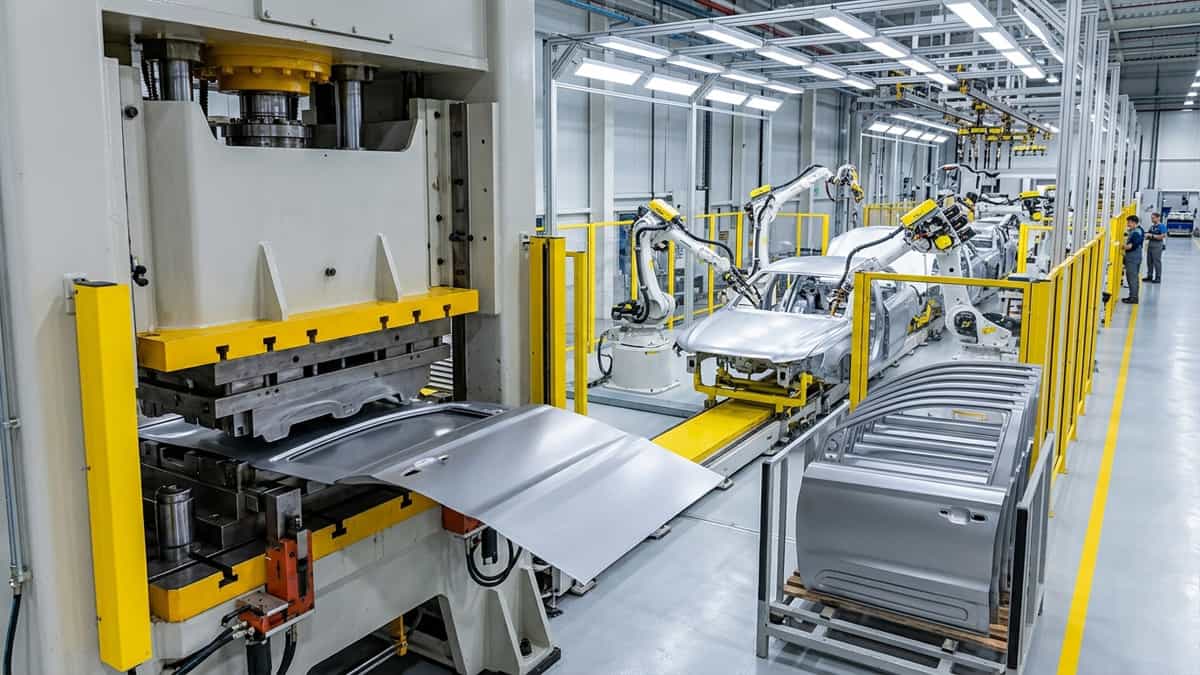
Aluminium 5754 – also known as Aluminum 5754 – is a non-heat treatable aluminium-magnesium alloy that strikes the perfect balance between strength, formability, and corrosion resistance. With a magnesium content of 2.6–3.6%, 5754 aluminum offers medium-to-high strength, excellent weldability, and outstanding performance in marine and automotive applications. It is the go-to alloy for vehicle body panels, general sheet metal work, and components requiring a combination of ductility and durability.
What is Aluminium 5754?
Aluminium alloy 5754 belongs to the 5xxx series of aluminum alloys, where magnesium is the primary alloying element. It is a non-heat treatable alloy, meaning its strength comes from cold working (strain hardening) rather than thermal processing. With a magnesium content of 2.6–3.6%, 5754 sits between 5052 (2.2–2.8% Mg) and 5083 (4.0–4.9% Mg) in terms of both strength and formability.
What makes Aluminium 5754 so popular is its versatility. It offers a compelling combination of properties that make it suitable for a wider range of applications than many of its 5xxx series cousins – from automotive panels and pressure vessels to welded structures and general fabrication.
Key Characteristics at a Glance:
| Property | Value |
|---|---|
| Density | 2.66–2.67 g/cm³ |
| Melting Range | 600 – 645 °C |
| Thermal Conductivity | 130 – 140 W/m·K |
| Modulus of Elasticity | 69 – 70 GPa |
| Electrical Resistivity | 32 – 34% IACS |
Data compiled from industry specifications
Chemical Composition of Aluminium 5754
Aluminium 5754 derives its balanced properties from a well-controlled composition. The magnesium content (2.6–3.6%) provides solid solution strengthening and excellent corrosion resistance. The addition of chromium (0.30% max) enhances stress-corrosion cracking resistance, particularly important for welded structures.
| Element | Percentage (%) |
|---|---|
| Aluminum (Al) | Balance |
| Magnesium (Mg) | 2.60 – 3.60 |
| Chromium (Cr) | 0.00 – 0.30 |
| Manganese (Mn) | 0.00 – 0.50 |
| Iron (Fe) | 0.00 – 0.40 |
| Silicon (Si) | 0.00 – 0.40 |
| Zinc (Zn) | 0.00 – 0.20 |
| Titanium (Ti) | 0.00 – 0.15 |
| Copper (Cu) | 0.00 – 0.10 |
| Others (Each) | 0.00 – 0.05 |
Source: BS EN 573-3 / ASTM B209 standards
Key Properties of Aluminium 5754
💪 Medium-to-High Strength with Good Formability
Aluminium 5754 offers a sweet spot between strength and formability. It is significantly stronger than 5052 yet more formable than 5083. This makes it ideal for applications that require both structural integrity and the ability to be shaped into complex forms.
Typical Mechanical Properties (Sheet – O Temper):
- Tensile Strength: 190 – 240 MPa
- Yield Strength (0.2%): ~80 MPa
- Elongation: 16 – 20%
Typical Mechanical Properties (Sheet – H22/H32 Temper):
- Tensile Strength: 210 – 270 MPa
- Yield Strength (0.2%): ~160 MPa
- Elongation: 8 – 12%
🌊 Excellent Corrosion Resistance – Including Marine
Aluminium 5754 offers excellent resistance to atmospheric corrosion and performs very well in marine environments – though not quite as resistant as 5083 or 5454 in continuous saltwater immersion. Its protective oxide film is stable across a wide pH range (approximately 4–9), making it suitable for many industrial and chemical environments.
“5754 has good corrosion resistance to marine atmospheres and industrial environments.”
🔧 Excellent Weldability
One of the standout features of Aluminium 5754 is its excellent weldability. It can be welded using all standard methods, particularly:
- MIG (GMAW) – most common
- TIG (GTAW) – for precision work
- Resistance welding
The recommended filler alloy is 5356 for maximum strength and corrosion resistance, though 4043 or 5183 can also be used depending on the application.
📐 Superior Formability
Aluminium 5754 is known for its good formability, especially in the annealed (O) and H111 tempers. It can be:
- Bent – with minimum bend radii as low as 0–1T in O temper
- Deep drawn – suitable for complex shapes like automotive panels
- Stamped – excellent for high-volume production
- Spun – can be formed on spinning lathes
⚙️ Machinability
Like most 5xxx series alloys, Aluminium 5754 has fair machinability – better than 5083 but not as good as 6061. For best results:
- Use sharp, carbide-tipped tools
- Apply adequate cutting fluid
- Employ high cutting speeds with positive rake angles
- Consider harder tempers (H32, H34) for machining operations
🌡️ Elevated Temperature Performance
While not as specialized as 5454, 5754 maintains reasonable properties up to approximately 100°C. For sustained exposure above 100°C or up to 170°C, 5454 or 5754 with careful design may be considered, but 5454 is the better choice for elevated-temperature service.
🔄 Common Tempers
| Temper | Description |
|---|---|
| O | Annealed – maximum formability |
| H111 | Slightly work-hardened (less than H11) |
| H22 / H32 | Quarter hard – good balance of strength and formability |
| H24 / H34 | Half hard / three-quarter hard – higher strength, reduced formability |
| H38 | Full hard – maximum strength, minimum formability |
Applications of Aluminium 5754
Thanks to its excellent combination of strength, formability, weldability, and corrosion resistance, Aluminium 5754 is one of the most versatile 5xxx series alloys, used across a wide range of industries.
🚗 Automotive & Transportation – The #1 Application
5754 aluminum is extensively used in the automotive industry for:
- Vehicle body panels – doors, hoods, roof panels, and tailgates
- Structural components – crash management systems, chassis parts
- Commercial vehicle bodies – truck cabs, trailer panels
- Bus body panels – lightweight and corrosion-resistant
- Fuel and oil lines – where moderate heat resistance is needed
“5754 is the standard alloy for automotive body panels in many European and Asian vehicles.”
-Ads-
⚓ Marine & Offshore
While 5083 is stronger and 5454 handles higher temperatures, 5754 is widely used in:
- Small boat hulls – dinghies, runabouts, and personal watercraft
- Boat interiors – decks, bulkheads, and cabin components
- Marine trim and fittings – where formability matters
- Dock components – ladders, handrails, and gangways
🏭 General Fabrication & Sheet Metal Work
5754 aluminum is a fabricator’s favorite for:
- Pressure vessels – low-to-medium pressure applications
- Storage tanks – for water, chemicals, and food products
- Pipework and ducting – HVAC and industrial ventilation
- General sheet metal fabrication – enclosures, covers, and housings
🏗️ Architectural & Building
- Roofing and cladding – especially in coastal areas
- Handrails and balustrades – welded structures
- Signage and display panels – where corrosion resistance is important
🥤 Consumer & Industrial Products
- Cooking utensils – pots, pans, and bakeware
- Food processing equipment – FDA-compliant surfaces
- Electrical enclosures – non-magnetic and corrosion-resistant
- Ladders and scaffolding – lightweight and durable
Aluminium 5754 vs. Other 5000 Series Alloys
Rather than a dense table, here is a practical guide to choosing between the most common 5xxx alloys:
| Alloy | Magnesium (%) | Strength | Formability | Corrosion Resistance | Best For |
|---|---|---|---|---|---|
| 5052 | 2.2–2.8 | Medium | Excellent | Good (marine) | Fuel tanks, general fabrication |
| 5754 | 2.6–3.6 | Medium-high | Very good | Very good (marine) | Automotive panels, general sheet metal |
| 5454 | 2.4–3.0 | Medium-high | Good | Excellent (marine + heat) | Pressure vessels, elevated-temperature service |
| 5083 | 4.0–4.9 | High | Fair | Excellent (marine) | Heavy-duty marine structures |
Pro Tip: Choose 5754 when you need a versatile alloy that balances strength, formability, and corrosion resistance for automotive, sheet metal, or general fabrication. Choose 5052 for maximum formability and lower cost. Choose 5083 for maximum strength in marine environments. Choose 5454 for elevated-temperature applications.
For a detailed, interactive side-by-side comparison of 5754 with any other aluminum alloy – including 5052, 5454, 5083, 6061, or 7075 – visit the Aluminium Alloy Comparison Tool. This tool allows you to compare over 40 alloy types across properties like strength, corrosion resistance, weldability, and thermal conductivity.
Fabrication & Workability Guide
🔨 Forming
Aluminium 5754 is highly formable, especially in O and H111 tempers. It can be deep drawn, bent, stamped, and spun. Minimum bend radii in O temper can be as low as 0–1× material thickness. For H22/H32, minimum bend radii increase to 1–2× thickness.
🔥 Welding
Excellent weldability – one of the best in the 5xxx series. Use:
- 5356 filler – best for strength and corrosion resistance
- 5183 filler – good for marine applications
- 4043 filler – acceptable for less critical work
Pre-heating is generally not required. Post-weld strength typically approaches the O temper values.
⚙️ Machining
Fair to moderate machinability – improves with harder tempers. Use carbide tools, positive rake angles, high cutting speeds, and ample lubrication. For extensive machining, consider 6061 or 2011 instead.
🌡️ Heat Treatment
Not heat treatable – annealing is the only thermal process. Anneal at approximately 345°C (650°F) for 2–3 hours, then air cool.
❄️ Cold Working
Excellent cold working capacity – the alloy strengthens significantly with cold work. Strain hardening tempers (H22 through H38) are achieved by cold rolling after annealing.
Why Choose Aluminium 5754?
✅ Advantages
- Excellent combination of strength and formability – the best balance in the 5xxx series
- Very good corrosion resistance – suitable for marine and industrial environments
- Excellent weldability – easy to fabricate using MIG/TIG
- Good machinability (in harder tempers)
- Versatile – used across automotive, marine, general fabrication, and consumer goods
- Non-heat treatable – no risk of improper thermal processing
- Fully recyclable – sustainable choice
- Cost-effective – generally lower cost than 5083
❌ Limitations
- Lower strength than 5083 – not suitable for heavy-duty marine hulls
- Not as heat-resistant as 5454 – loses strength above ~100°C
- Machinability only fair – not suitable for precision machining without care
- Cannot be heat treated – strength limited to cold work
- Not suitable for strong acids or caustics (pH <4 or >9)
Summary
Aluminium 5754 (Aluminum 5754) is the versatile workhorse of the 5000 series. It strikes a near-perfect balance between strength, formability, weldability, and corrosion resistance – making it the preferred choice for automotive body panels, general sheet metal fabrication, and a vast range of industrial applications.
While it may not match the extreme strength of 5083 or the elevated-temperature performance of 5454, Aluminium 5754 offers a compelling all-rounder solution that meets the needs of most medium-strength, corrosion-resistant applications. From the car you drive to the boat you sail and the equipment you use daily, 5754 aluminum is quietly delivering reliable performance around the world.
📚 Related Articles
Deepen your understanding of aluminum alloys with these curated guides:
- Aluminium Alloy Comparison Tool – Compare 40+ aluminum alloys side by side to find the perfect material for your project
- Aluminium 5052: The Marine-Grade Alloy for Superior Corrosion Resistance – The standard 5xxx alloy for fuel tanks and general fabrication
- Aluminium 5454: The Elevated-Temperature Marine Alloy – The specialist for pressure vessels and chemical storage
- Aluminium 6061 T6 Alloy: Properties, Machining & Applications – The heat-treatable alternative for higher strength requirements
- Types of Aluminium Sheets Used in Construction – Explore sheet forms of 5754 and other alloys
Related Articles

Featured

You May Also Like

Discover the Best UK Regions for Aluminium Windows Based on …

Aluminum Rivets: Purpose, Types, and Applications
Aluminum Fencing Business: The Complete Guide

Bifold Vs. French Casement Vs. Sliding for Patio Door

Aluminium Windows Problem: Condensation on Glass Panes
