
Why This Word Is Everywhere in Architecture
Walk into any architectural discussion, read a construction magazine, or listen to a building designer. You will hear the word facade constantly. Architects, builders, and developers use it because it captures something essential about a building – its outer face, its personality, and its performance all at once.
Yet most people misunderstand the term. They think a facade is just a decorative front, like a movie set. That is not true in modern construction. A facade today is a sophisticated, engineered system that protects occupants, saves energy, and defines a building’s identity.
Let’s clear up the confusion.
So, What Does Facade Actually Mean?
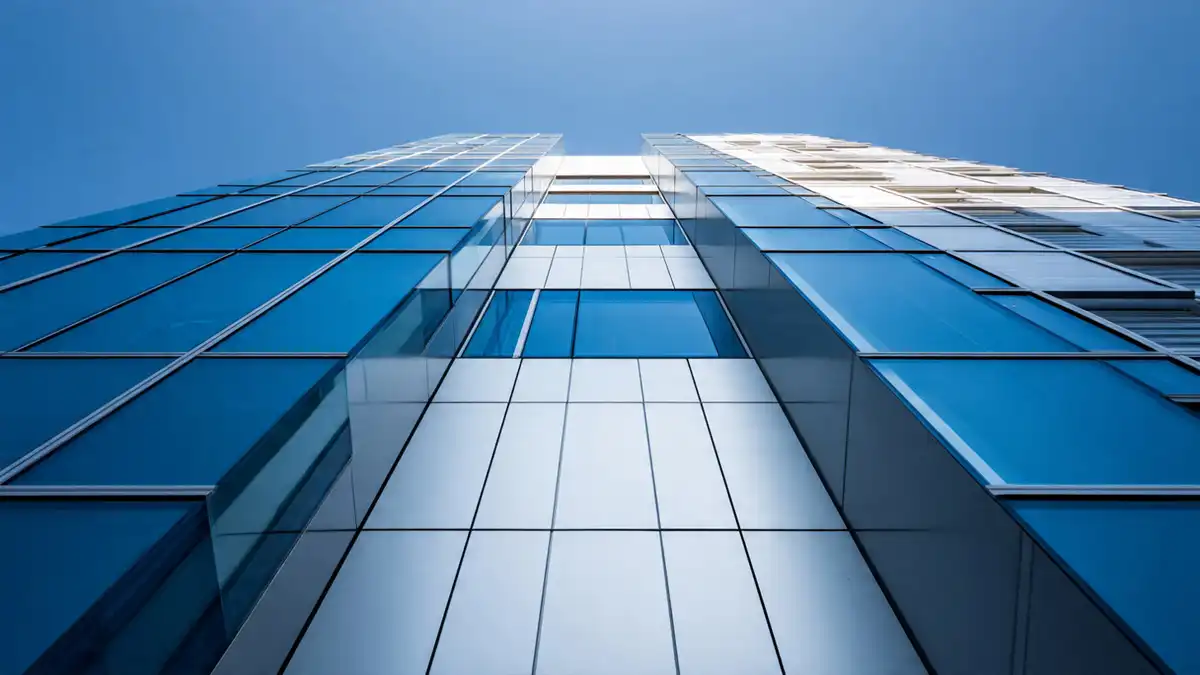
In plain English, a facade is the entire exterior envelope of a building – all sides, not just the front. The word comes from French (façade), meaning “face.” But in modern architecture, it means much more than a pretty face.
A facade includes:
- All exterior walls
- Windows and doors
- Cladding materials (metal, glass, stone, panels)
- Insulation layers
- Structural connections to the building frame
Why does the meaning matter? Because today’s facades are not just walls. They are climate control systems, structural skins, and energy managers. The term has evolved from “front decoration” to “complete exterior engineering system.”
Facade vs Exterior: Are They the Same?
Not exactly. The difference is subtle but important.
| Term | Meaning |
|---|---|
| Exterior | Any outside surface or area. Includes walls, roof, ground, sidewalks. A broad term. |
| Facade | Specifically the vertical exterior walls of a building, especially when considered as a designed system. |
Professionals do not use them interchangeably. You would say “the building’s facade is leaking” (meaning the wall system). You would not say “the building’s exterior is leaking” (too vague). Facade implies engineering and assembly. Exterior is just location.
The Real Purpose of a Building Facade
A modern facade has four essential jobs:
Protection from weather
Wind, rain, snow, sun, and temperature swings – the facade is the first line of defense. It keeps water out and structural elements dry.
Energy performance
A well-designed facade reduces heating and cooling loads. It uses insulation, thermal breaks, and solar control glazing to cut energy bills by 20–40% compared to basic walls.
Visual identity
The facade is what people see. It communicates the building’s character – modern, traditional, high‑tech, sustainable. It is often the reason a building becomes a landmark.
Structural coordination
The facade does not hold up the building (that is the frame’s job), but it must safely attach to the frame, allow for movement (wind, seismic, thermal expansion), and transfer wind loads back to the structure.
What Makes Up a Modern Facade?
A typical modern facade is a layered assembly. From outside to inside:
| Layer | Typical Material |
|---|---|
| Outer weather skin | Glass, aluminium panels, stone, terracotta |
| Air cavity / drainage | Ventilated gap (10–50 mm) |
| Insulation | Mineral wool, foam board |
| Vapor barrier | Membrane or foil |
| Structural backup | Steel studs, concrete, or aluminium mullions |
| Interior finish | Drywall, plaster, or exposed structure |
The most critical component for high‑performance facades today is the aluminium framing system – it holds the glass or panels, provides drainage channels, and accommodates thermal expansion.
For a detailed look at one popular facade type, see our guide on curtain walls system for glass buildings.
Different Types of Facades You See Today
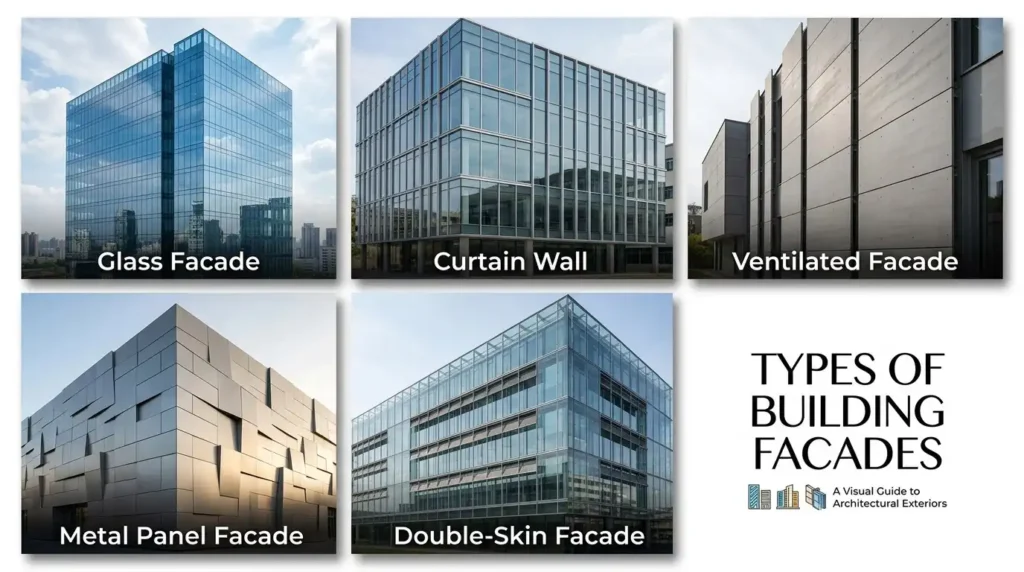
Here are the most common facade types with quick practical explanations:
1. Glass Facades
Almost entirely glass, supported by aluminium mullions. Common in office towers. Excellent daylight but requires solar control (Low‑E coatings, fritted glass) to avoid overheating.
2. Curtain Wall Facades
A non‑load‑bearing aluminium and glass wall that hangs on the building structure. Used in high‑rise construction. Can be stick-built (on site) or unitized (factory panels).
3. Ventilated Facades (Rain screen)
An outer layer (metal, ceramic, wood composite) held away from the insulation by a cavity. Air flows behind the panels, removing moisture and heat. Excellent for both hot and cold climates.
4. Metal Panel Facades
Aluminium, steel, or zinc sheets formed into flat or corrugated panels. Durable, lightweight, and available in many colors. Often used in airports, warehouses, and industrial buildings.
5. Double‑Skin Facades
Two glass layers with a wide air cavity between them (often 300–1000 mm). The cavity can be used for natural ventilation, solar shading, or winter heating. However, to be truly effective in high‑rise buildings, double‑skin facades almost always require automated controls – smart actuators that open and close vents, blinds, or dampers based on temperature, wind, or CO₂ levels. Manual operation is rare above the ground floor. These systems are high‑performance but expensive.
Learn more about aluminium cladding types and applications to understand panel facades in depth.
Why Modern Buildings Depend on Facade Systems
Modern construction would be impossible without advanced facade systems. Here is why:
- Heat control – Without a proper facade, glass buildings become greenhouses in summer and heat sieves in winter. Thermal breaks and insulated glazing solve this.
- Wind resistance – Tall buildings face high wind pressures (up to 150 km/h). Facade systems are engineered to resist both pushing and pulling forces.
- Durability – Aluminium and glass facades last 30–50 years with minimal maintenance. They do not rot, warp, or spall like some traditional materials.
- Design flexibility – Curved, angled, or stepped facades are possible. Aluminium extrusions can be custom-shaped to any geometry.
Why Aluminium Changed Facade Design
Aluminium is not just a convenience for facades – it is the enabling material. Before aluminium, steel frames were heavy and prone to rust. Wood frames could not span large glass areas. Aluminium changed everything.
Lightweight strength – Aluminium weighs about one‑third of steel for the same stiffness. This allows slimmer frames and larger glass panels.
Corrosion resistance – Aluminium naturally forms a protective oxide layer. With anodized or powder‑coated finishes, it withstands coastal salt air and industrial pollution for decades.
Slim profile possibilities – Because aluminium is strong and light, facade mullions can be as narrow as 50 mm. This maximizes the glass area and gives buildings that “seamless” look.
For the material that makes all this possible, read about aluminium extrusion in modern construction – the process that creates those complex facade profiles.
Common Misconceptions About Facades
“It’s just decoration”
False. A facade is a functional, load‑transferring, weather‑proofing system. Decoration is a minor part.
“Facade only means glass buildings”
Not true. Stone, metal, brick, wood, and composite facades are common. Glass is simply the most visible.
“Any exterior wall is a facade”
No. A basic concrete or masonry wall without insulation, drainage, or attachment engineering is just a wall – not a modern facade system.
Facade Meaning in Real Buildings
Let’s look at real building types and what their facades do:
| Building Type | Facade Role | Common Materials |
|---|---|---|
| Office tower | Maximize daylight, manage solar heat, resist wind | Glass curtain wall, aluminium mullions |
| Airport terminal | Large spans, durability, easy cleaning | Metal panels, double‑skin glass |
| Shopping mall | Visual attraction, weather protection, signage integration | Glass, stone, aluminium composite panels |
| Premium residential | Thermal comfort, acoustic insulation (often the #1 priority for buyers in noisy cities), balcony integration | Ventilated facades, aluminium‑clad wood, triple‑glazed windows |
For a sustainability‑focused example, see how aluminium forms the backbone of solar BIPV facades – a growing trend in green buildings.
Facade, Curtain Wall, and Cladding: What’s the Difference?
This is the most common confusion. Here is a clear comparison.
| Term | Definition | Scope | Example |
|---|---|---|---|
| Facade | The entire exterior wall system of a building (all sides, all materials) | Broadest | Every external wall of a building |
| Curtain wall | A specific type of non‑load‑bearing facade made of aluminium and glass | Sub‑category of facade | Glass tower skin |
| Cladding | The outer layer or skin attached to a backup wall. It does not include the primary structure, though it usually has a secondary sub‑frame (attachment rails, brackets, or rails) that connects the cladding panels to the building. | Component of facade | Metal panels on a high‑rise |
Think of it this way:
- Facade is the whole meal.
- Curtain wall is one dish on the menu (glass restaurant).
- Cladding is the garnish on top (with its own small fork – the sub‑frame).
Why Understanding Facades Matters
Different people need to understand facades for different reasons:
For architects – The facade is the primary expression of design. Getting it right means balancing aesthetics, cost, and physics.
For builders – Facades are high‑cost, high‑risk systems. Poor installation leads to leaks, lawsuits, and reputation damage.
For property owners – A good facade lowers energy bills, reduces maintenance, and increases asset value. A bad facade is a financial drain.
For buyers/tenants – The facade affects comfort (temperature, noise), views, and even health (daylight, fresh air). It is not just “looks.”
Quick Takeaway
- A facade is the entire engineered exterior wall of a building – not just the front, and not just decoration.
- Modern facades protect, insulate, drain, and resist wind while defining visual identity.
- Aluminium is the dominant material because it is light, strong, and corrosion‑proof.
- Do not confuse facade with curtain wall (a type of facade) or cladding (a component – with its own secondary sub‑frame).
- Understanding facades helps architects, builders, owners, and buyers make better decisions.
Related Articles
Featured



You May Also Like

What is Aluminium Checker Plate?
Do You Know? How Curtain Wall Systems Handle Wind Load &…
NTPC REL Floats 300 MW Solar Project Tender in Goa, Aluminiu…
Aluminum Arsenide (AlAs): The Complete Guide

90% of LME Aluminium Under One Party: Who Controls LME Alumi…
