Why Do Modern Glass Buildings All Look the Same?
Walk through any major city today. Offices, shopping malls, airports, and even luxury hotels all seem to share the same design language: floor‑to‑ceiling glass, sleek metallic frames, and a seamless, reflective exterior. This is not a coincidence.
The hidden system behind this global architectural trend is called the curtain wall. It has fundamentally changed how buildings are designed, constructed, and experienced. Without curtain walls, the iconic glass towers of New York, Dubai, and Singapore would not exist.
So, what exactly is a curtain wall, and why has it become the default choice for modern construction?
Curtain Wall vs Traditional Wall (Straight to the Point)
The key difference between a traditional wall and a curtain wall is structural responsibility.
- Traditional load‑bearing wall – Made of brick, concrete, or stone. It supports the weight of the floors and roof above it. You cannot remove it without risking collapse.
- Curtain wall (non‑load‑bearing) – It does not support the building. Instead, it hangs on the outside of the structural frame (columns, beams, slabs). Think of it as a lightweight, weatherproof “skin” that wraps the building.
A Simple Structural Analogy
- The human body relies completely on a skeleton (the structural building frame).
- Our skin, clothing, and outer protective tissue layers act as a curtain wall. They shield against wind and rain elements but carry no internal body weight. Your skeletal backbone handles that entirely.
- This clean separation of the main load-bearing core from the exterior facade enclosure is exactly what makes soaring modern glass skyscrapers engineeringly possible.
What Actually Makes a Curtain Wall System
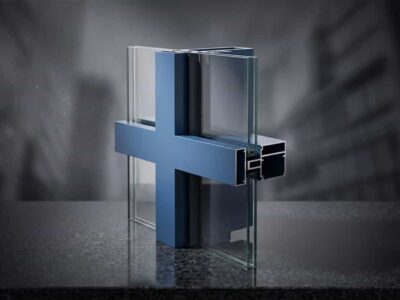
A typical curtain wall consists of four main components:
| Component | Function |
|---|---|
| Aluminium framing (mullions & transoms) | Vertical (mullion) and horizontal (transom) members create the grid that holds everything together. |
| Glass panels (infill) | The visible surface. Can be single, double, or triple glazed, with various coatings. |
| Gaskets & sealants | Rubber or silicone seals prevent air and water infiltration at the joints between glass and frame. |
| Anchoring system | Brackets, bolts, and clips that connect the curtain wall to the building’s structural slab edges or columns. |
All these components work together to keep the building dry, thermally stable, and visually stunning.
The Two Main Types (Where the Real Decision Happens)
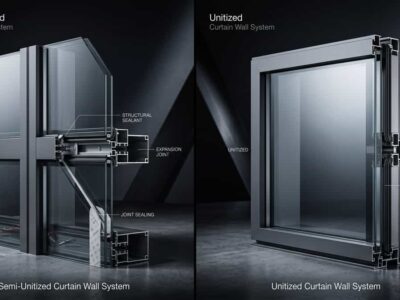
When specifying a curtain wall, the first major decision is between stick and unitized systems.
1. Stick System (Built on Site)
The stick system arrives at the construction site as individual extrusions (sticks) and glass panels. Workers assemble the frame piece by piece on scaffolding, then install the glass.
When it’s used: Low‑ to mid‑rise buildings (up to 10–15 floors), or projects where budget is tighter and installation speed is not critical.
STICK SYSTEM PROS
- ✓ Lower upfront raw material and extrusion fabrication costs.
- ✓ Highly flexible layout that is easy to modify or adjust directly on the construction site.
- ✓ Streamlined shipping logistics with no large factory setup or specialized container transit required.
CONS
- ✕ Highly weather-dependent layout; site installation is immediately delayed by rain, heavy wind, or snow.
- ✕ Significantly longer on-site assembly, framing, and glazing timeline.
- ✕ Final structural quality depends heavily on the field installer’s baseline manual skills.
2. Unitized System (Factory‑Made Panels)
Unitized curtain walls are pre‑assembled in a factory into complete panels (typically one floor tall and one mullion bay wide). These panels arrive at the job site ready to be lifted by crane and bolted directly to the building’s edge slabs.
Why it dominates high‑rise construction:
UNITIZED SYSTEM PROS
- ✓ Rapid Installation Speed: Specialized field crews can anchor several full floor levels per working day.
- ✓ High Structural Consistency: Controlled plant assembly ensures razor-sharp micro tolerances and seamless seals.
- ✓ Reduced Risk Footprint: Factory precision mitigates field-seal structural leakage risks over the building lifespan.
CONS
- ✕ Substantially higher initial upfront engineering and fabrication system cost.
- ✕ Demands sophisticated field logistics, matching flatbed transit scheduling with on-site staging crane access.
- ✕ Zero flexibility for on-site changes once individual panels have completed manufacturing lines.
Comparison Table: Stick vs Unitized Curtain Wall
| Feature | Stick System | Unitized System |
|---|---|---|
| Assembly location | On‑site | Factory |
| Installation speed | Slow | Fast |
| Best building height | Low to mid‑rise | High‑rise (20+ floors) |
| Weather dependency | High | Low (panels are pre‑sealed) |
| Initial cost | Lower | Higher |
| Quality control | Variable | Excellent |
For a deeper technical comparison, see our guide on stick vs unitized curtain walls (standards overview).
How Curtain Walls Handle Real‑World Conditions
Curtain walls are not just decorative. They must survive extreme conditions.
Performance Engineering Parameters
- ✓ Wind Pressure Resistance: Engineered to withstand positive load pressure pushing in and negative suction loads pulling outward. Rigorously tested under ASTM E330 or AAMA 501 baselines.
- ✓ Rainwater Management: Incorporates pressure-equalized rain screens. Water bridging the perimeter profile boundaries is safely corralled into internal gutter extrusions and expelled through weep holes.
- ✓ Thermal Expansion Flexibility: Accommodates aluminum frame thermal shifts (approx. 0.023 mm per meter per °C) smoothly using dynamic sliding joint gaps and pliable framing seals.
- ✓ Structural Displacement Support: Protects against wind sway, settling, and seismic loads through slotted anchors that prevent structural forces from cracking the glass infill panels.
Curtain Wall Section Explained (Without Engineering Complexity)
Imagine cutting a horizontal slice through a curtain wall. From outside to inside, you would see:
- Outer glass pane – Typically 6–8 mm thick, sometimes coated with Low‑E or reflective finish.
- Air gap – 12–20 mm (or filled with argon gas for insulation).
- Inner glass pane – Another 6–8 mm layer.
- Aluminium frame (mullion) – A hollow extrusion, usually 50–200 mm wide, with thermal breaks.
- Gasket and sealant – Compressed rubber or silicone at the glass‑to‑frame contact.
- Insulation – Fibrous or foam insulation stuffed behind the frame (inside the building’s spandrel area).
- Interior cover trim – A decorative aluminium snap‑on cap that hides fasteners.
This layered assembly is what gives curtain walls their strength, weather resistance, and thermal performance.
Why Aluminium Is the Preferred Material
Almost all modern curtain walls use aluminium extrusions for the framing. Why?
- Lightweight vs steel – Aluminium weighs about one‑third as much as steel for the same strength. This reduces dead load on the building structure and makes installation safer.
- Corrosion resistance – Aluminium naturally forms a protective oxide layer. With anodized or powder‑coated finishes, it lasts decades even in coastal environments.
- Design flexibility – Aluminium can be extruded into complex shapes (e.g., thermal break cavities, weep holes, gasket grooves) that would be expensive or impossible with steel.
For more on how aluminium performs in facade systems, read our article on aluminium cladding types and applications.
Energy Efficiency: Reality vs Marketing Claims
Curtain walls have a mixed reputation for energy efficiency. Here is the reality.
Good curtain walls can be very efficient – when designed with:
High-Efficiency Baseline Requirements
- ✓ Thermal Breaks: Polyamide barriers engineered inside the frame channel to actively prevent thermal bridging across the outer envelope.
- ✓ Insulated Glazing: Double or triple-layer glass assemblies isolated with low-conductivity internal gas fields.
- ✓ Low-E Glass Elements: Advanced metallic coats calibrated to intercept external infrared rays while admitting pure visible light layers.
Bad curtain walls (non‑thermal break, single glazing) are energy disasters – they act like giant heat sinks in winter and solar ovens in summer.
The marketing claim “curtain walls are energy efficient” is only true if you pay for thermal breaks and high‑performance glass. Budget systems will fail every time.
Learn more about thermal break technology in our guide on what are thermal break aluminium windows (the same principle applies to curtain walls).
Where Curtain Walls Make Sense (And Where They Don’t)
✅ Commercial buildings (strong fit)
- Office towers
- Hotels
- Airports
- Shopping malls
- Hospitals and institutional buildings
Why? High visibility, need for natural light, and ability to justify higher upfront cost through long‑term value.
⚠️ Residential use – limited and conditional
- Luxury high‑rise apartments (yes, if properly specified)
- Single‑family homes (rarely makes sense – too expensive and technically complex)
- Townhouses (only in very specific modern designs)
Why not? Residential buildings typically have lower budgets, smaller scale, and less tolerance for installation errors.
Cost vs performance perspective
Curtain walls are expensive. A typical stick system costs $50–$150 per square foot installed. Unitized high‑rise systems can exceed $200 per square foot. In contrast, traditional punched windows with spandrel panels cost $30–$70 per square foot. You choose a curtain wall for aesthetics, speed of high‑rise construction, or large uninterrupted glass areas – not for low initial cost.
Cost Breakdown (What Really Affects Pricing)
Five factors dominate curtain wall costs. Understand these before budgeting:
| Cost Factor | Impact | Notes |
|---|---|---|
| Glass type | High | Double glazing Low‑E vs triple glazing vs insulated spandrel. More layers = higher cost. |
| System type | High | Stick is cheaper upfront; unitized costs more but saves installation time on tall buildings. |
| Building height | Medium | Wind loads increase with height; requires stronger members and thicker glass above ~30 floors. |
| Location & labor | Medium | Union vs non‑union, local codes, and shipping distance for unitized panels. |
| Thermal performance | Medium | Adding a thermal break adds 10–20% to extrusion cost but is mandatory for energy codes in cold climates. |
Realistic expectation: For a typical 20‑story office building in the US, expect $80–$120 per square foot for a quality stick‑built curtain wall with double glazing and thermal breaks. Unitized will add $20–$40 more.
Common Mistakes to Avoid
Even a well‑designed curtain wall fails if these mistakes are made:
- Choosing the lowest‑cost system – Cheap extrusions, thin glass, and poor seals guarantee leaks within 5–10 years.
- Wrong glass selection – Using clear glass in a hot climate (excessive solar gain) or tinted glass where daylighting is critical (dark interiors).
- Poor installation – The single biggest failure point. Improperly torqued anchors, misaligned mullions, or tears in gaskets cause air and water infiltration that is expensive to fix after the building is finished.
- Ignoring thermal bridging – Non‑thermal break frames will sweat, mold, and increase HVAC costs regardless of the glazing.
Always require AAMA or ASTM mock‑up testing before full installation. Any reputable curtain wall contractor will agree to this.
Curtain Wall v/s Window Systems
People often confuse curtain walls with ordinary window systems. They are not the same.
| Feature | Curtain Wall | Window System (e.g., storefront, punched windows) |
|---|---|---|
| Structural role | Non‑load‑bearing skin | Non‑load‑bearing, but spans only a single opening |
| Span | Multiple floors, continuous | Single opening (one room) |
| Installation | Hung on slab edges or columns | Set into rough openings in a backup wall |
| Typical use | Entire building facade | Individual rooms, residential, light commercial |
| Complexity | High (engineered system) | Low (catalog products) |
When to use each:
- Use a curtain wall when you want a continuous glass facade across multiple floors.
- Use window systems for individual openings in a building that already has an exterior wall (brick, concrete, metal panel).
Quick Summary for Decision‑Makers
5 key takeaways:
1. A curtain wall is a non‑load‑bearing exterior skin – it hangs on the structure, it does not hold it up.
2. Aluminium is the dominant material because of its light weight, corrosion resistance, and extrudability.
3. Stick systems are cheaper but slower; unitized systems are faster and higher quality, ideal for tall buildings.
4. Energy performance is not automatic – you must specify thermal breaks and insulated glazing.
5. Curtain walls are expensive ($80–$200/sq ft). They make sense for commercial high‑rise buildings but rarely for single‑family homes.
Should you consider a curtain wall?
- Yes – if you are building a multi‑story office, hotel, airport, or institutional building and want a modern glass aesthetic with large, uninterrupted views.
- Maybe – for luxury high‑rise residential, but only with proper thermal breaks and installation oversight.
- No – for low‑budget projects, small buildings, or any project where installation quality cannot be guaranteed.
Related Articles
Explore these aluminium magazine resources for deeper information:
- Aluminium in facade systems – global standards (ASTM, AAMA, EN)
- What are thermal break aluminium windows?
- Aluminium extrusion in modern construction