
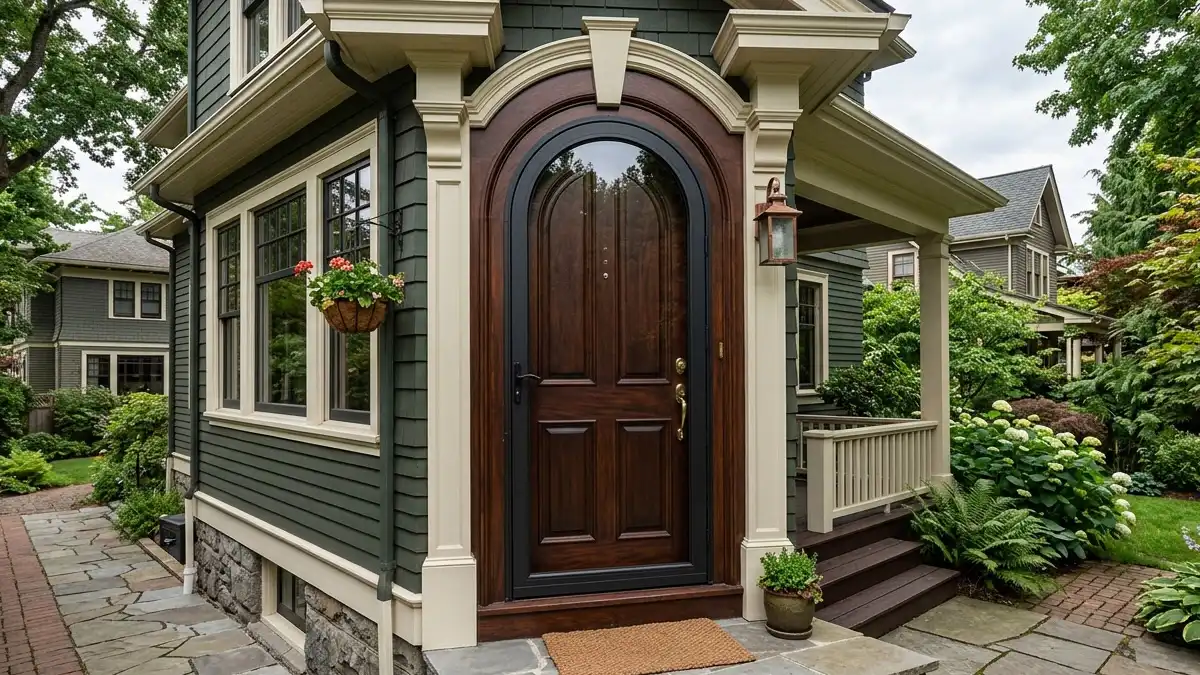
Your home is unique. Your front door shouldn’t be forced into a mass-produced aluminum frame built for standard suburban rough openings.
Historic homes, custom builds, and even older houses that have settled over a century often have entryways that don’t match modern dimensions. Door openings can be 30 inches wide, 39 inches wide, or completely irregular. Arched tops, transoms, sidelights, and non-rectangular shapes add complexity.
Standard storm doors won’t fit. And forcing them to fit means cutting trim, shimming unevenly, and ending up with an air‑leaking, awkward‑looking mess.
Custom storm doors solve this. Fabricated to the exact fraction of an inch, they preserve architectural character while delivering modern protection.
This guide covers when you need a custom door, how the ordering process works, which materials handle odd shapes best, and what to expect for cost and lead time.
When Standard Storm Doors Won’t Work
You need a custom storm door if any of these apply:
- Non‑standard width: Rough opening under 31 inches or over 37 inches (most standard doors fit 31.5–37.5 inches)
- Non‑standard height: Under 78 inches or over 83 inches (standard is 80–82 inches)
- Arched or curved top: The door header is not straight
- Uneven jambs: The opening is out of square by more than 1/4 inch (older homes settle)
- Historic preservation requirements: You must match existing trim profiles or avoid modern appearance
- Sidelights or transoms: You need a custom configuration that covers only the door, not the glass beside it
- Unusual threshold height: The door sits significantly above or below the exterior floor level
If you tried to install a standard storm door and the fitter said “we’ll need to build out the frame” or “we’ll have to cut the brick mold”—that’s a sign you should go custom.
For a baseline understanding of storm door functions that apply even to custom builds, see our what do storm doors do for a home guide.
Historic Homes: Special Considerations
Historic homes present two challenges: preserving character and dealing with settled, non‑square openings.
Preserving character: A chunky, high‑gloss, full‑view storm door looks wrong on a Victorian or Craftsman. Custom fabricators can match:
- Trim profiles to existing window and door casings
- Divided light patterns (mullions or grilles) that echo the primary door
- Period‑appropriate hardware (escutcheons, rim locks, wrought‑iron style handles)
- Finish colors to match existing paint or stained wood
Dealing with settlement: A 100‑year‑old house has moved. The door opening is rarely perfectly rectangular. A custom door is measured on‑site, then fabricated to the actual shape—including slight trapezoidal adjustments. Some custom shops will even template the opening (trace the exact shape onto cardboard) before manufacturing.
Material choice: Extruded aluminum is preferred for historic homes because it can be powder‑coated to any color (including historically accurate shades) and formed into complex profiles without the weight or rust of steel. Wood‑core doors rot; aluminum doesn’t.
For finish options that suit historic homes, see our powder coating vs. anodizing guide. Anodized finishes look industrial; powder‑coated matte or satin finishes match painted wood better.
Custom Sizing: What You Need to Measure
If you order a custom storm door, you must provide accurate measurements. Errors are expensive.
Tools needed: Tape measure, level, pencil, paper. For complex shapes, cardboard templates.
Step‑by‑step:
- Width at top, middle, and bottom – Measure inside the existing door frame (jamb to jamb). Use the smallest of the three as your nominal width.
- Height at left and right – From the top of the threshold to the underside of the header. Use the smaller measurement.
- Diagonal corner‑to‑corner – Measure both diagonals. If they differ by more than 1/4 inch, your frame is out of square. Note the difference for the fabricator.
- Threshold depth and angle – How far does the threshold project? Is it sloped?
- Handle clearance – Distance from the primary door handle to the storm door frame when the main door opens. For outswing doors, this is critical.
Many custom fabricators will send a technician to measure for an additional fee ($100–150). For historic homes or very irregular openings, this is money well spent.
For mobile home owners with odd sizes, some of the same principles apply—see our storm doors for mobile homes guide for sizing tips.
Arched and Curved Tops
An arched entry is beautiful. It’s also a nightmare for standard rectangular storm doors.
Custom arched storm doors are fabricated in two ways:
- True arched frame – The aluminum extrusion is bent to match the curve. Requires specialized equipment. More expensive but perfect fit.
- Rectangular door with arched insert – The outer frame is rectangular; the glass panel is cut in an arch shape, with the gap filled by aluminum or wood filler. Less expensive but slightly less elegant.
What to ask a custom fabricator:
- Can you bend extruded aluminum to my specific radius?
- What is the minimum radius you can achieve? (Some shops won’t bend below 12 inches)
- Do you offer segmented (facetted) arches as a lower‑cost alternative?
For true historic accuracy (e.g., a Gothic Revival pointed arch or a Roman semicircle), expect to pay a premium. A good custom shop will create a wood pattern and bend aluminum around it.
Materials for Custom Storm Doors
| Material | Pros | Cons | Best For |
|---|---|---|---|
| Extruded aluminum | Lightweight, rust‑proof, any color, complex shapes possible | Higher cost | Most custom applications |
| Steel | Very strong, traditional appearance | Heavy, rusts, hard to bend precisely | Security‑focused historic? Not recommended |
| Wood core | Matches historic trim perfectly | Rot, maintenance, warping | Preservation projects with budget for annual painting |
| Fiberglass | Moldable, paintable | Less rigid, can yellow in sun | Moderate‑cost custom shapes |
Aluminum is the best choice for 95% of custom storm doors. It accepts powder coating in any RAL color, won’t rot or rust, and can be extruded or bent into almost any profile.
For coastal historic homes (Charleston, Savannah, Cape Cod), specify anodized aluminum rather than powder‑coated. Anodizing resists salt corrosion and won’t peel if scratched.
Ordering Process and Lead Times
Typical custom storm door workflow:
- Measure or template (1–2 hours on‑site)
- Shop drawing approval (1–2 weeks) – The fabricator sends a dimensioned drawing. Review carefully.
- Fabrication (2–6 weeks) – Depends on complexity and shop backlog.
- Shipping (1–2 weeks) – Custom doors are often shipped by freight due to odd sizes.
- Installation (2–4 hours) – Professional recommended.
Total timeline: 4–10 weeks from initial contact to installed door. Plan ahead—don’t order in October for winter installation.
Cost range:
| Complexity | Price Range (door only) |
|---|---|
| Simple rectangle, standard dimensions (but not carried in stock) | $500–800 |
| Non‑standard width/height (e.g., 30″ wide, 78″ tall) | $600–1,000 |
| Out‑of‑square jamb accommodation | $700–1,200 |
| Arched top (true bent aluminum) | $1,200–2,500 |
| Full historic reproduction (custom trim profiles, divided lights, period hardware) | $2,000–4,000+ |
Compare to a premium standard storm door at $350–600. Custom costs more, but it’s the only option for many homes.
For a baseline reference on premium standard doors, see our best aluminum storm doors for front entrances buyer’s guide.
Installation Tips for Non‑Standard Openings
Even a custom door needs careful installation when the opening is irregular.
- Use composite shims – Not wood (which compresses and rots). Shim behind the hinge jamb to bring it plumb.
- Don’t force square – If your opening is trapezoidal, the door should be trapezoidal too. Forcing a rectangular door into a parallelogram cracks the glass.
- Spray foam – Use minimal‑expanding foam (window and door formula) to fill gaps between the storm door frame and the rough opening. Standard foam can bow the frame.
- Drip cap must overhang – On historic homes without overhangs, a wide drip cap (4–6 inches) is essential.
If the primary door itself is historic and irreplaceable, consider a storm door that mounts with minimal screws into the brick mold (rather than through it). Some custom shops offer bracket‑mount systems that avoid drilling into antique wood.
Finding a Custom Storm Door Fabricator
What to look for:
- Specializes in extruded aluminum fabrication (not just reselling standard sizes)
- Offers on‑site measuring or templating
- Provides shop drawings for approval
- Has experience with historic homes (ask for references or photos)
- Uses 6063‑T5 aluminum and powder‑coating or anodizing in‑house
National custom fabricators to research:
- Pinkys (historic reproduction storm doors)
- Rustica Hardware (custom sizes, modern styles)
- Custom Storm Doors by Design (specializes in odd dimensions)
Always get a written quote that includes shop drawing approval, shipping terms, and warranty (minimum 1 year on fabrication, 5–10 years on finish).
The Bottom Line
A custom storm door is an investment—in both protection and architectural integrity. For historic homes, it’s the only way to add a storm door without ruining the character. For non‑standard openings, it’s the only way to get a proper fit.
Your checklist for ordering custom:
- Measure the opening in six places (top/middle/bottom width; left/center/right height)
- Check for out‑of‑square (compare diagonals)
- Decide on arched or rectangular
- Choose extruded aluminum with powder‑coated or anodized finish
- Request shop drawings and approve carefully
- Budget 4–10 weeks lead time and $600–2,500+
- Hire professional installation for irregular jambs
Skip the frustration of forcing a standard door into an opening it was never designed for. One custom door, built correctly, will last 25+ years and look like it belongs from day one.
Related Articles
Featured


You May Also Like

Understanding Aluminium Waste and Scrap

Why Aluminum Bathroom Windows Are Ideal for Canadian Weather

Aluminum Can Recycling: The 60-Day Loop & 95% Energy Sav…

Aluminium Chlorate (Al(ClO₃)₃): The Complete Guide

Switching to Aluminium? Here’s Why It’s a Strategic Power Mo…
