
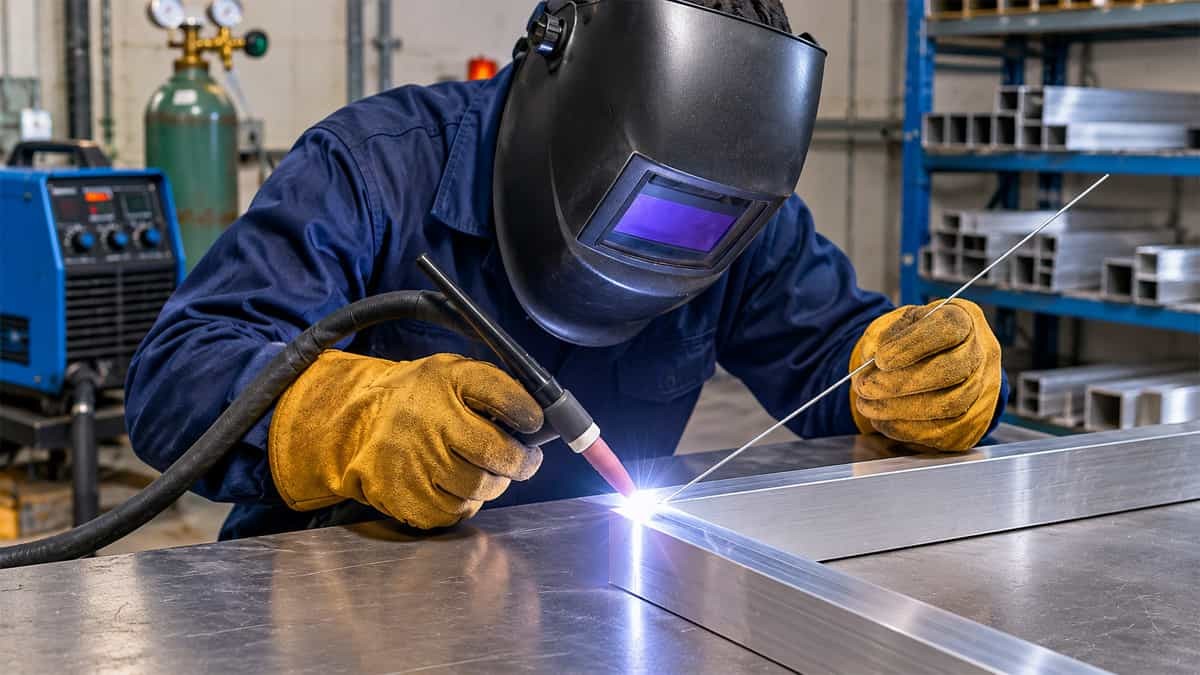
Aluminum to aluminum welding requires more than applying heat and adding filler metal. Aluminum forms a high-melting-point oxide layer on its surface, conducts heat rapidly away from the weld zone, and absorbs hydrogen easily—leading to porosity or cracking if the process, polarity, and filler alloy are not matched correctly.
TIG and MIG welding are the primary fusion methods for joining aluminum to aluminum, while specialized coated aluminum stick electrodes handle select field repairs and low-temperature brazing rods offer a torch-based option when base-metal fusion is not required.
6 THINGS TO CHECK BEFORE WELDING ALUMINUM
- 1. Base Alloy Weldability: Confirm your alloy grade first—5xxx and 6xxx series (like 5052 and 6061) weld reliably, while aerospace grades like 2024 and 7075 are prone to severe hot cracking.
- 2. Oxide vs. Base Metal: Pure aluminum melts at 660°C (1,220°F), whereas its surface oxide melts at 2,050°C (3,720°F)—requiring acetone degreasing, dedicated stainless-steel brushing, and AC cleaning action.
- 3. Best Method by Thickness: Use AC TIG for thin-to-medium sheets (1 mm–6 mm), DCEP MIG (with a spool gun) for thicker sections (3 mm+), and SMAW stick for heavy field repairs (4 mm+).
- 4. Polarity & Shielding Gas: Set AC for TIG or DCEP for MIG/Stick, and use 100% pure argon shielding gas (never CO₂ or standard steel C25 mixes).
- 5. Filler Rod Selection: Choose ER4043 for crack resistance and smooth flow on 6061 aluminum, or ER5356 for higher shear strength, anodizing color match, and marine-grade 5xxx alloys.
- 6. Welding Stick vs. Brazing Rod: True stick electrodes fuse the base metal with an electric arc, while torch-heated brazing rods melt at lower temperatures (380°C–400°C) without melting the base aluminum.
Quick Facts About Aluminum to Aluminum Welding
| Question | Short Answer |
|---|---|
| Can aluminum be welded to aluminum? | Yes, using AC TIG, DCEP MIG (with spool gun), or specialized aluminum SMAW electrodes |
| Which method is most common? | AC TIG for thin/precision work; MIG for faster production on thicker stock |
| Can a stick welder join aluminum? | Yes, using DC-capable stick machines and coated aluminum electrodes (such as E4043) |
| Can aluminum be joined without a welding machine? | Yes, using torch-applied aluminum brazing rods or structural two-part epoxies for light-duty joints |
| Which shielding gas is required? | 100% pure argon for standard TIG and MIG (argon-helium mixes are used on heavy plate) |
| Which filler rods are standard? | ER4043 (silicon-based) and ER5356 (magnesium-based) cover most 5xxx and 6xxx alloys |
| Can different aluminum alloys be welded together? | Yes, weldable grades like 6061 and 5052 can be joined using ER5356 filler |
Recommended
Aluminium 6351 T6: The High‑Strength Structural Alloy for Marine and Transport Applications
Why Is Aluminum to Aluminum Welding Different from Steel Welding?
Aluminum behaves very differently from carbon steel under an arc. Three physical and metallurgical properties dictate how you set up your machine and prepare the joint.
1. Aluminum Has a High-Melting-Point Oxide Layer
Exposed aluminum instantly reacts with oxygen to form a thin, refractory aluminum oxide skin. The melting-point gap between the two layers creates a major welding hurdle:
- Pure aluminum melts at approximately 660°C (1,220°F).
- Aluminum oxide melts at approximately 2,050°C (3,720°F).
Because the oxide stays solid long after the metal beneath it has liquefied, unremoved oxide gets trapped inside the molten pool, causing lack of fusion and weak spots. AC TIG welding blasts away this oxide via cathodic cleaning, but mechanical brushing before striking an arc remains mandatory.
2. Aluminum Transfers Heat Rapidly
Aluminum conducts heat roughly four to five times faster than carbon steel. Heat drains out of the weld zone rapidly, forcing you to start with higher amperage to establish a puddle—and then taper off quickly as the part heat-soaks to prevent sudden burn-through on thin sections.
3. Molten Aluminum Absorbs Hydrogen (Porosity)
Liquid aluminum dissolves hydrogen readily, but solid aluminum holds almost none. As the weld pool freezes, trapped hydrogen escapes as gas bubbles, leaving tiny voids (porosity) that weaken the joint. Moisture, shop oils, mill scale, and damp filler rods are the primary hydrogen sources.
Don't Miss
Beyond the Tape Measure: Why Aluminium Producers Are Turning to Non-Contact Shape Measurement
What Are the Best Methods for Welding Aluminum to Aluminum?
Selecting the right joining process comes down to material thickness, structural load, and shop equipment.
TIG Welding (GTAW) — Best for Precision & Thin Gauge (1 mm – 6 mm)
Gas Tungsten Arc Welding (TIG) uses a non-consumable tungsten electrode and a separate hand-fed filler rod. For aluminum, the machine must be set to AC (Alternating Current) with high-frequency start; DCEN fails to break the oxide layer, while DCEP overheats and melts the tungsten.
How TIG aluminum welding works:
- Degrease the joint with acetone and brush away surface oxide using a dedicated stainless-steel brush.
- Set your machine to AC, adjust AC balance (typically 65%–75% EN for penetration), and set 100% pure argon shielding gas.
- Strike an arc and establish a shiny, fluid weld pool within 2–3 seconds.
- Dab compatible filler rod into the leading edge of the puddle while maintaining a 10°–15° forward push angle.
- Taper amperage via the foot pedal at the end of the pass and add a final dab of filler to prevent crater cracks.
ADVANTAGES
- ✓ Unmatched heat and puddle control via foot pedal
- ✓ Cleanest, cosmetic-grade weld beads with zero spatter
- ✓ Ideal for thin sheet metal, tubing, and precision repairs
LIMITATIONS
- ✕ Slow travel speed compared to MIG
- ✕ Steep learning curve requiring two-hand coordination
- ✕ Requires a dedicated AC/DC TIG power source
MIG Welding (GMAW) — Best for Production & Thicker Stock (3 mm+)
Gas Metal Arc Welding (MIG) continuously feeds a solid aluminum wire electrode through the gun using DCEP (Direct Current Electrode Positive) polarity and 100% pure argon. Because aluminum wire is soft and prone to buckling (“bird-nesting”) inside standard steel liners, a spool gun or push-pull gun with U-groove drive rolls and a Teflon liner is strongly recommended.
How MIG aluminum welding works:
- Clean the base metal thoroughly and verify U-groove drive rolls and an oversized contact tip are installed.
- Set polarity to DCEP and dial in spray-transfer voltage and wire speed for your material thickness.
- Hold the gun at a 10°–15° push angle (never pull/drag aluminum MIG, as dragging traps soot and oxide).
- Move briskly along the joint with a steady travel speed to avoid burn-through.
ADVANTAGES
- ✓ High deposition rates for fast fabrication and long seams
- ✓ Easier to learn for basic structural joints on thicker plate
- ✓ High productivity on repetitive production runs
LIMITATIONS
- ✕ Soft wire feeds poorly without a spool gun or push-pull setup
- ✕ Difficult to weld sheet thinner than 2–3 mm without burn-through
- ✕ Produces more soot and spatter than AC TIG
Stick Welding Aluminum (SMAW) — Best for Heavy Field Repairs (4 mm+)
Shielded Metal Arc Welding (SMAW) can join aluminum using flux-coated aluminum electrodes (such as E4043) on a DC stick welder set to DCEP (reverse polarity). Standard steel rods (6011, 7018) will not work. Because aluminum electrodes burn fast and require high heat, thick sections (6 mm and above) often benefit from a 150°C–200°C preheat.
ADVANTAGES
- ✓ Requires no external shielding-gas cylinder—ideal for windy outdoor jobs
- ✓ Works on standard DC stick welders without spool guns or AC TIG boxes
- ✓ Portable setup for heavy equipment and cast repairs
LIMITATIONS
- ✕ Rough bead appearance with heavy spatter and corrosive flux slag
- ✕ Unusable on thin sheet metal under 3–4 mm
- ✕ Flux coatings absorb moisture rapidly and must be kept dry
Aluminum Brazing — Best for Thin Sheet & Non-Structural Fixes (< 3 mm)
Brazing joins aluminum at temperatures between 380°C and 580°C—melting a zinc-aluminum or aluminum-silicon filler rod into the joint by capillary action without melting the base aluminum. It works well for radiator fins, thin tubing, and light brackets using a propane, MAPP, or oxy-acetylene torch.
ADVANTAGES
- ✓ Requires only an inexpensive handheld torch—no welding machine needed
- ✓ Low risk of warping or melting thin-gauge sheet aluminum
- ✓ Easy to learn for household and automotive trim repairs
LIMITATIONS
- ✕ Not a true fusion weld; lower shear and fatigue strength than TIG/MIG
- ✕ Unsuitable for high-load structural frames or high-heat engine parts
- ✕ Requires strict oxide removal and tight joint clearances
TIG vs. MIG vs. Stick Welding vs. Brazing
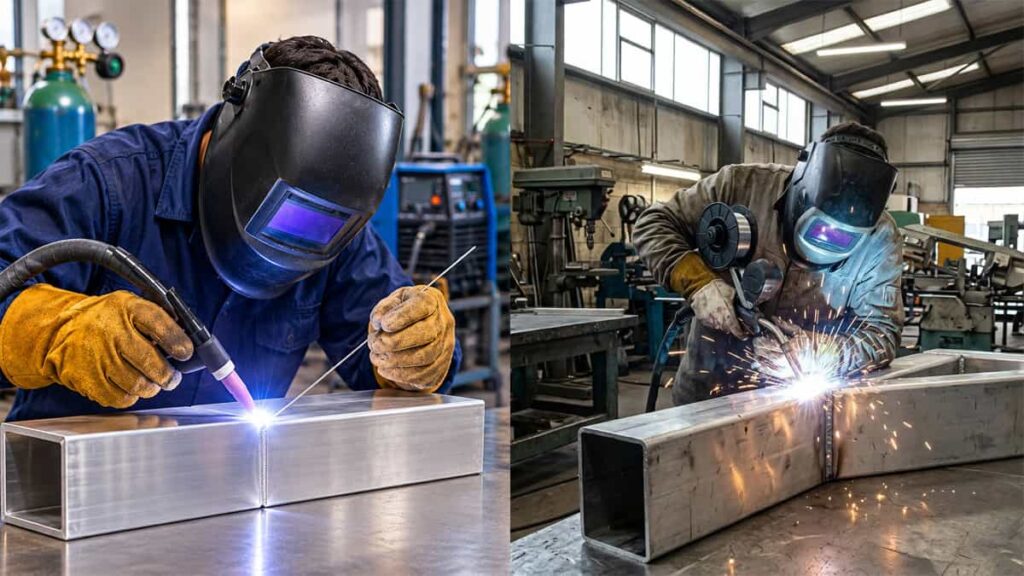
| Method | Best Thickness | Polarity & Gas | Main Advantage | Main Limitation |
|---|---|---|---|---|
| TIG (GTAW) | 1 mm – 6 mm | AC + 100% Argon | Highest precision & cleanest weld | Slow; requires high skill |
| MIG (GMAW) | 3 mm and thicker | DCEP + 100% Argon | Fast deposition for production | Needs spool gun for smooth feeding |
| Stick (SMAW) | 4 mm and thicker | DCEP + No gas (flux) | Portable; works outdoors | Heavy slag, spatter & rough bead |
| Brazing | Under 3 mm | Torch flame + Flux/rod | No welding machine required | Lower strength; non-fusion joint |
Can You Weld Aluminum Using a Welding Stick or Rod?
Yes, but retailers sell two completely different products under the name “aluminum welding stick.” Buying the wrong one will leave you with a rod that cannot work with your heat source.
1. True Aluminum Stick Electrodes (SMAW)
These are solid aluminum core wires coated in a thick white or gray flux jacket (AWS E4043). You clamp them into a stick-welder electrode holder (DCEP) to strike an electric arc that melts both the rod and the base aluminum.
2. Low-Temperature Aluminum Brazing Rods
Often marketed online as “easy aluminum welding rods,” these bare zinc-aluminum rods are heated with a propane or MAPP gas torch. They melt around 380°C–400°C and bond to the surface without melting the base aluminum. They cannot be used in an arc welder.
| Feature | Aluminum Stick Electrode (SMAW) | Aluminum Brazing / Repair Rod |
|---|---|---|
| Joining Process | True arc fusion welding | Low-temperature brazing / soldering |
| Heat Source | DC Stick-welding machine (DCEP) | Propane, MAPP, or oxy-fuel torch |
| Base Metal | Melts and fuses with filler | Remains solid below melting point |
| Typical Use | Thick plate, castings, field repairs | Thin sheet, HVAC tubing, light brackets |
Other No-Welder Alternatives: If open flame is not an option—such as thin body panels, fuel tank patches, or cosmetic trim—two-part structural metal-filled epoxies or mechanical fasteners (blind rivets) provide reliable cold-joining without heat distortion.
Choose the Right Aluminum Filler Rod
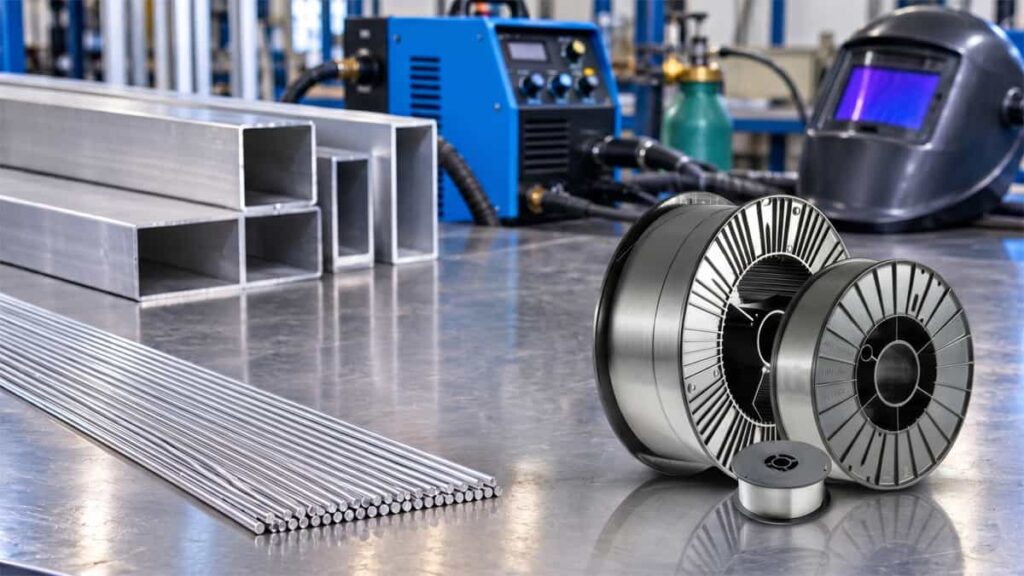
Matching your filler metal to the base alloy prevents solidification cracking and ensures the joint meets strength or corrosion requirements. Over 90% of general aluminum fabrication uses either ER4043 or ER5356.
ER4043 (Aluminum-Silicon Filler)
Alloyed with 5% silicon, ER4043 has a lower melting point and high fluidity, making it the go-to choice for 6061 and cast aluminum alloys. It flows smoothly, resists hot cracking, and is more forgiving for newer aluminum welders—though it turns dark gray if the part is later anodized.
ER5356 (Aluminum-Magnesium Filler)
Alloyed with 5% magnesium, ER5356 delivers higher shear strength and ductility than ER4043. It is mandatory for 5xxx-series marine alloys (5052, 5083) and preferred on 6061 when parts require post-weld anodizing or higher structural load capacity. However, it should not be used in sustained service temperatures above 65°C (150°F) due to stress-corrosion cracking risks.
| Feature | ER4043 | ER5356 |
|---|---|---|
| Primary Alloying Element | Silicon (5%) | Magnesium (5%) |
| Hot-Crack Resistance | Higher on 6xxx and cast alloys | Better on 5xxx alloys |
| Weld Shear Strength | Moderate (~27 ksi) | Higher (~38 ksi) |
| Puddle Fluidity | High (wetting, smooth bead) | Slightly stiffer puddle |
| Anodized Color Match | Turns dark gray/black | Matches base aluminum closely |
| Max Service Temp | Suitable above 65°C (150°F) | Limit to under 65°C (150°F) |
Critical Rule: Never use ER4043 on high-magnesium alloys like 5083 or 5456—excess magnesium silicide forms in the weld, making the joint brittle. For heavy marine structures (5083/5086), step up to ER5183 or ER5556.
Can You Weld Different Aluminum Alloys Together?
Yes—most 1xxx, 3xxx, 5xxx, and 6xxx series alloys can be welded to one another provided you select a filler compatible with both base metals. However, heat-treatable aerospace alloys in the 2xxx (2024) and 7xxx (7075) series are prone to severe hot cracking and are generally joined via mechanical fasteners or friction stir welding instead of arc welding.
| Aluminum Combination | Recommended Filler & Notes |
|---|---|
| 6061 to 6061 | ER4043 (easiest flow/crack resistance) or ER5356 (higher strength/anodizing) |
| 5052 to 5052 | ER5356 (do not use ER4043) |
| 5083 to 5083 | ER5183 or ER5356 for full structural strength |
| 6061 to 5052 | ER5356 safely bridges both magnesium and magnesium-silicon chemistries |
| 6061 to 3003 | ER4043 or ER5356 (ER4043 wets easily on thin 3003 sheet) |
| 2024 or 7075 | Not recommended for conventional TIG/MIG due to extreme hot-cracking susceptibility |
How to Prepare Aluminum Before Welding
Skipping surface prep is the single biggest cause of dirty, porous aluminum welds. Follow this exact sequence immediately before welding:
PRE-WELD ALUMINUM PREPARATION CHECKLIST
- ✓ 1. Identify the Alloy Grade: Check mill markings or material specs to confirm weldability (avoid 2024/7075) and match your filler rod.
- ✓ 2. Degrease First: Wipe the joint area with acetone or a dedicated aluminum degreaser and a clean lint-free cloth. Always degrease before brushing so you do not grind oil into the metal.
- ✓ 3. Brush the Oxide Layer: Scrub the weld zone with a dedicated stainless-steel wire brush used exclusively on aluminum. Never use a brush that touched carbon steel, as embedded iron particles will cause rust and weld contamination.
- ✓ 4. Bevel Thick Edges: For butt joints thicker than 3 mm–4 mm, bevel the edges (30°–37.5° per side) to ensure full-penetration fusion.
- ✓ 5. Clean Your Filler Rod: Wipe bare TIG filler rods with an acetone-dampened lint-free wipe before welding to remove mill oils and fingerprints.
- ✓ 6. Verify Polarity & Gas Flow: Confirm AC for TIG or DCEP for MIG/Stick, and set pure argon flow to 15–25 CFH (7–12 L/min) with no drafts blowing across the worktable.
What Are Common Problems in Aluminum to Aluminum Welding?
| Welding Problem | Primary Cause | Immediate Fix |
|---|---|---|
| Porosity (Pinholes) | Oil, moisture, dirty filler, or insufficient argon coverage | Re-degrease with acetone, use dry filler, check gas cup/flow rate |
| Crater / Hot Cracking | Wrong filler alloy, high joint restraint, or abrupt arc stop | Switch to ER4043 (on 6061), taper current slowly, fill end crater |
| Burn-Through | Too much amperage as part heat-soaks | Increase travel speed, reduce amperage, or back joint with a copper chill bar |
| Lack of Fusion (“Cold Lap”) | Unremoved oxide layer or insufficient starting heat | Brush oxide thoroughly and wait for a shiny puddle before adding filler |
| Smut / Black Soot | Dragging MIG gun or improper AC balance on TIG | Use a 10°–15° forward push angle and check shielding gas purity |
| Warping / Distortion | Excessive heat input on long continuous runs | Tack-weld every 50–75 mm and use a backstep or stitch welding sequence |
FAQs
Can you weld two pieces of aluminum together?
Yes. Two aluminum pieces can be joined permanently using AC TIG welding, DCEP MIG welding (with a spool gun), or specialized aluminum stick electrodes, provided the alloys are weldable and matched with a compatible filler metal like ER4043 or ER5356.
Is TIG or MIG better for aluminum welding?
AC TIG is better for thin aluminum (1 mm–6 mm), precision fabrication, and clean cosmetic welds. DCEP MIG is better for thicker sections (3 mm+) and high-speed production runs where deposition rate matters more than bead aesthetics.
Can you use a regular stick welder on aluminum?
Yes, provided your machine supports DC Electrode Positive (DCEP) and you use flux-coated aluminum electrodes (such as E4043). Standard mild-steel rods like 6011 or 7018 cannot weld aluminum.
Do you need argon gas to weld aluminum?
Yes, both TIG and MIG aluminum welding require 100% pure argon shielding gas (or an argon-helium mix for thick industrial plate). Flux-coated aluminum stick electrodes and torch brazing rods do not require external shielding gas.
Can you weld aluminum without filler metal?
Autogenous welding (fusing without filler) is rarely recommended for aluminum because most structural grades—especially 6061—suffer severe solidification cracking unless diluted with silicon- or magnesium-rich filler metal.
Can aluminum be welded to aluminum using a propane torch?
A propane or MAPP torch can join aluminum using low-temperature zinc-aluminum brazing rods (melting around 380°C–400°C). While effective for thin sheet and light repairs, this is brazing rather than fusion welding and has lower structural strength.
Why does aluminum crack after welding?
Aluminum cracks primarily from using an incompatible filler alloy, welding non-weldable grades (like 2024 or 7075), or breaking the arc abruptly without filling the end crater.
Is aluminum brazing as strong as aluminum welding?
No. Fusion welds (TIG/MIG) melt the base aluminum into a continuous metallurgical bond, whereas brazed joints rely on surface adhesion of a lower-melting filler alloy and are unsuitable for heavy structural loads.
Successful aluminum-to-aluminum welding comes down to preparation and process matching rather than brute heat. Use AC TIG for thin, detailed work, DCEP MIG with a spool gun for thicker production parts, and reserve SMAW stick electrodes or torch brazing rods for targeted field and light-duty repairs. Identify your alloy first, scrub the oxide layer with a dedicated stainless brush, and match your filler rod to the base metal for clean, crack-free joints.
SAFETY NOTE
- Eye & Skin Protection: Aluminum reflects intense ultraviolet radiation—wear an auto-darkening helmet (Shade 10–13) and full leather/FR coverage.
- Fume & Solvent Safety: Ensure active fume extraction, especially when burning flux coatings on stick/brazing rods, and let acetone evaporate completely before striking an arc to prevent fire or phosgene gas hazards.
- Structural Verification: Load-bearing frames, pressure vessels, and transportation components must be welded and inspected to qualified codes (such as AWS D1.2).
Sources & Technical References
- Fractory – Aluminium Welding Explained — Overview of oxide layer challenges, porosity causes, and industrial joining methods.
- Lincoln Electric – Best Practices to Weld Aluminum in the Trailer Industry — Practical troubleshooting for cracking, distortion, and filler metal selection.
- Lincoln Electric – Aluminum MIG Welding Guide — Technical comparison of ER4043 vs. ER5356 filler wires and alloy compatibility.
- Indiana Department of Transportation – Aluminum Welding Specifications — Standard alloy-to-filler pairing guidelines for structural aluminum fabrication.
Featured


You May Also Like

Powering Everyday Life: The Uses of Aluminium Wire

How Much Aluminum Hydroxide Is in Toothpaste? A Scientific R…

Aluminum Wheels: The Raw, Lightweight, and Performance Alloy…

Aluminium Powders & Flakes: GST Rates & HSN Codes

Beyond the Frame: 6 Residential Glass Profiles to Secure and…
