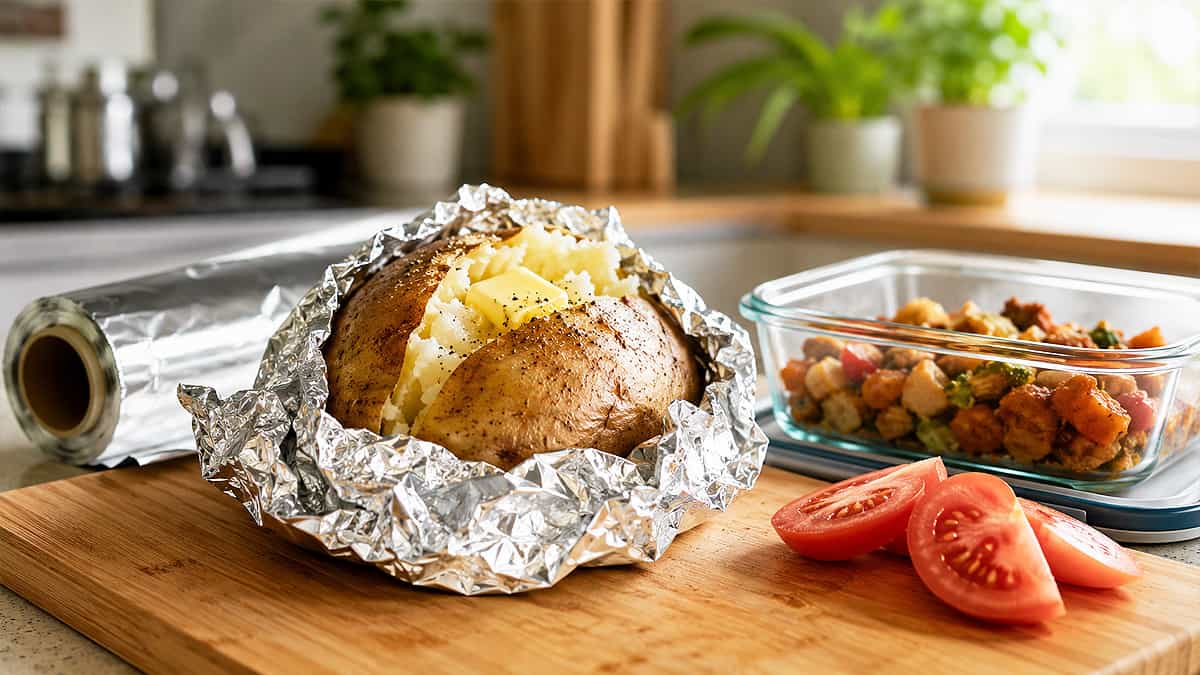
Aluminum foil is a kitchen staple, but advice about storing food in it can get confusing. Some people say you should never use foil for food storage, while others use it for leftovers, baked potatoes and sandwiches without a second thought.
The truth is less dramatic.
Aluminum foil can be used safely for many food-storage situations. The bigger questions are what food you are storing, how long it stays at room temperature, how quickly it is refrigerated, and whether the food is acidic or salty.
Here are some common aluminum foil food-storage myths—and the facts behind them.
Myth 1: You Should Never Store Food in Aluminum Foil
Truth: Aluminum foil can be used to cover and store many foods safely.
The main food-safety issue is not simply whether leftovers are wrapped in foil. Perishable food needs to be refrigerated promptly, whether it is covered with foil, placed in a container or stored another way.
The USDA recommends refrigerating perishable leftovers within two hours of cooking or serving. When the surrounding temperature is above 90°F, the limit is one hour.
For large amounts of leftovers, divide the food into smaller portions and use shallow containers. This helps the food cool more quickly in the refrigerator.
So the real rule isn’t “never use foil.” It is “don’t leave perishable food sitting at unsafe temperatures.”
Myth 2: Foil-Wrapped Baked Potatoes Are Always Safe
Truth: Baked potatoes wrapped in foil need special attention.
Potatoes can carry spores of Clostridium botulinum, the bacterium associated with botulism. When a cooked potato is tightly wrapped in foil, the environment can become low in oxygen.
That does not mean every foil-wrapped baked potato is dangerous. The concern arises when the potato is kept at unsafe temperatures for an extended period.
The USDA has specifically warned about foil-wrapped baked potatoes that are improperly stored at room temperature.
If you bake potatoes in foil, don’t leave them sitting out for extended periods. Leftover potatoes should be refrigerated promptly, and storing them in smaller portions can help them cool more quickly.
This is one of the few situations where the combination of foil, low oxygen and improper temperature control deserves particular attention.
Myth 3: Acidic Foods Become Dangerous When Wrapped in Foil
Truth: Acidic foods can interact with aluminum, but this is generally a quality concern.
Foods such as tomatoes and citrus fruits are acidic and can react with aluminum, particularly when they remain in direct contact with foil for a prolonged period.
The result can include a metallic taste, discoloration or changes to the surface of the foil.
That does not mean the food automatically becomes unsafe.
Still, if you need to store highly acidic or salty foods for an extended period, a suitable food-storage container is a better choice than keeping them directly against aluminum foil.
Myth 4: Wrapping Hot Food in Foil Keeps It Safe Until You Refrigerate It
Truth: Foil does not make hot food safe to leave out.
Wrapping very hot food tightly can retain heat. The important issue is that perishable food should not remain in the temperature range where bacteria can multiply rapidly.
Instead of leaving a large hot dish on the counter until it completely cools, divide it into smaller portions and refrigerate it promptly in shallow containers.
The goal is to move food through unsafe temperatures efficiently—not to wait for it to reach room temperature before putting it in the refrigerator.
Myth 5: Reheating Makes Mishandled Food Safe Again
Truth: Reheating is not a reset button for improperly stored food.
If food has remained at unsafe temperatures long enough for harmful bacteria to multiply, reheating may not eliminate every food-safety risk.
Some bacteria can produce toxins that are not necessarily destroyed by normal cooking or reheating.
That is why safe storage matters before reheating ever becomes necessary.
If leftovers were left out too long, reheating them later should not be treated as a guaranteed way to make them safe.
Myth 6: Aluminum Foil Is the Main Food-Safety Problem
Truth: Time and temperature are often more important than the foil itself.
It is easy to blame aluminum foil because it is the part you can see.
But consider two different situations: a leftover wrapped in foil and promptly refrigerated, and the same leftover wrapped in foil and left on the kitchen counter for several hours.
The foil is present in both cases. The storage conditions are what make the difference.
That is why food-safety advice focuses so heavily on temperature control, storage time and proper refrigeration.
So, Is It Safe to Store Food in Aluminum Foil?
Generally, yes. You do not need to stop using aluminum foil for food storage.
Just use it appropriately.
Keep these simple rules in mind:
- Refrigerate perishable leftovers within the recommended time.
- Divide large quantities into shallow containers so they cool more quickly.
- Give foil-wrapped baked potatoes particular attention and do not leave them at room temperature for extended periods.
- Avoid prolonged direct contact between aluminum foil and highly acidic or salty foods when practical.
- Do not rely on reheating to rescue food that has already been stored improperly.
The biggest myth is that aluminum foil itself makes food unsafe.
The more useful truth is much simpler: safe food storage depends on the food, time, temperature and storage method—not just the foil.
Related Articles

Featured

You May Also Like
Aluminium 1100-H18 and 1145-H19

Does the Aluminium Door Window Business require any knowledg…

Aluminium 5083 (Aluminum 5083): The High‑Strength Marine All…

Why Aluminum is Classified as a Nonrenewable Resource
Which Products Are Made of Aluminium? Ever Noticed These Aro…