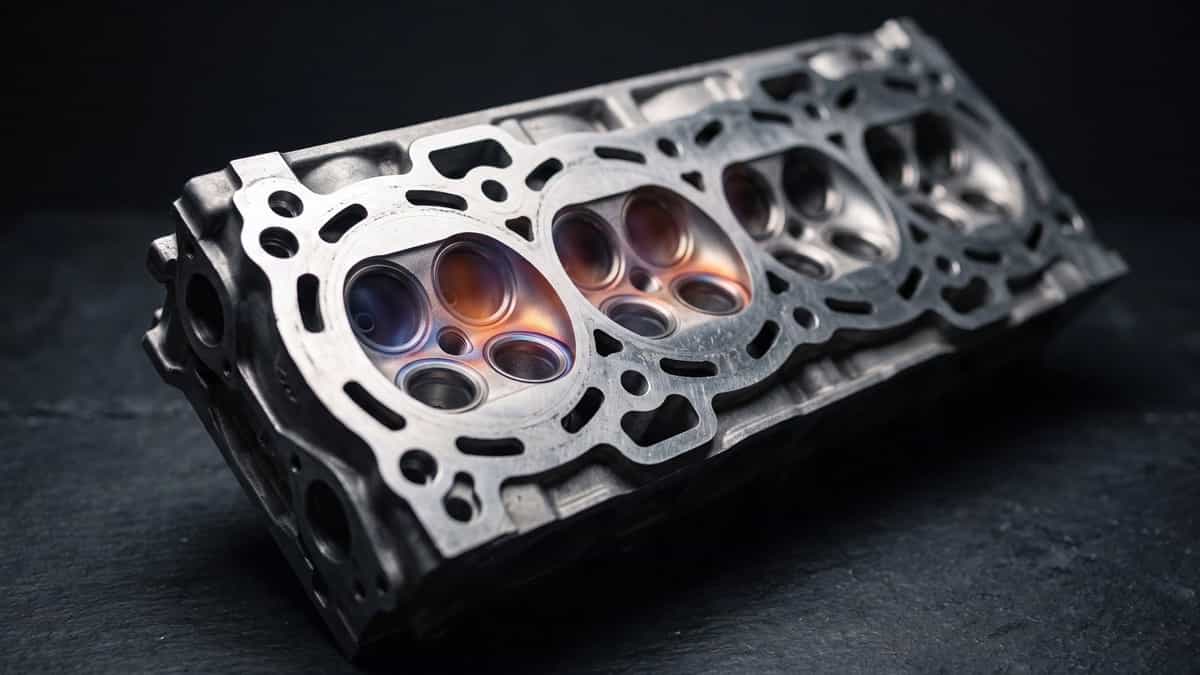
The cylinder head is one of the most thermally and mechanically stressed components in any internal combustion engine. It must seal the combustion chamber, house the valvetrain, manage intake and exhaust flow, and channel coolant—all while withstanding thousands of thermal cycles over its service life. For decades, cast iron was the default material for this demanding role. Today, however, the vast majority of production engines—from economy hatchbacks to high-performance sports cars—rely on aluminium cylinder heads.
The shift from iron to aluminium is not simply a weight-saving exercise. It reflects a fundamental rethinking of how heat, pressure, and fatigue interact inside an engine. This article examines what aluminium cylinder heads are, why they replaced cast iron, which alloys are used, how they are manufactured, and where the engineering challenges remain.
KEY TAKEAWAYS
- Aluminium heads weigh roughly half as much as equivalent cast-iron heads.
- They provide 2-3x better thermal conductivity for improved heat dissipation.
- Al-Si-Cu and Al-Si-Mg are the most commonly used alloy families.
- Thermal expansion and casting porosity remain the primary engineering challenges.
What Is an Aluminium Cylinder Head?
An aluminium cylinder head is a precision casting that sits atop the engine block, closing the top of the cylinders and forming the combustion chambers. It contains the intake and exhaust ports, valve guides, valve seats, and—in overhead-cam designs—the camshaft bearings and associated oil galleries. In modern engines, it also integrates coolant jackets that manage the extreme thermal loads generated during combustion.
Unlike the engine block, which primarily carries structural loads, the cylinder head must balance structural rigidity with effective heat dissipation. Aluminium casting alloys—typically silicon-based, with magnesium and/or copper additions—are chosen for their combination of castability, strength, thermal conductivity, and relatively low weight.
Why Automakers Use Aluminium Instead of Cast Iron
Weight
The most immediate advantage is mass reduction. Aluminium is roughly one-third the density of cast iron, and an aluminium cylinder head weighs approximately half as much as an equivalent cast-iron component. Because the cylinder head sits high on the engine, reducing its mass improves vehicle balance, lowers the center of gravity, and contributes to better handling and fuel efficiency.
Thermal Conductivity
Aluminium cylinder-head alloys generally conduct heat roughly two to three times better than typical cast iron, although the exact difference depends on the specific alloys being compared. This is not a marginal difference. A cylinder head that dissipates heat more effectively runs cooler, which can help support higher compression ratios, reduces the risk of detonation (knock), and lowers the temperature gradients across the casting. Lower gradients mean less thermal distortion and a reduced likelihood of hot spots that can trigger pre-ignition.
Castability and Design Freedom
Aluminium alloys can be cast into complex geometries with thinner walls and more intricate internal passages than cast iron. This allows engineers to integrate coolant jackets, oil galleries, and port shapes that would be difficult or impossible to achieve in iron. The result is a head that can be optimized for airflow, combustion efficiency, and thermal management simultaneously.
Aluminium Cylinder Head vs Cast Iron
ADVANTAGES
- ✓ Excellent castability for complex geometries
- ✓ Superior thermal conductivity reduces hot spots
- ✓ Significant mass reduction improves handling and efficiency
- ✓ Easier to machine during manufacturing
LIMITATIONS
- ✕ Higher material and processing costs
- ✕ Greater thermal expansion requires strict gasket management
- ✕ More prone to warping if the engine overheats
- ✕ Valve seats cannot be cast integrally (requires inserts)
The choice between the two materials is rarely absolute. Many engines—particularly those designed before the widespread adoption of all-aluminium architectures—used aluminium heads on cast-iron blocks. This combination works, but it introduces a thermal expansion mismatch that must be managed through gasket design and fastener strategy.
Which Aluminium Alloys Are Used in Cylinder Heads?
Common cylinder-head alloys come from Al-Si-Cu and Al-Si-Mg families, including 319-type and 356/A356 alloys. These are not exotic aerospace alloys; they are workhorse casting alloys selected for their balance of castability, strength, and thermal stability.
The 319-type alloys (Al-Si-Cu) offer good strength at elevated temperatures, which makes them useful for high-temperature and highly loaded cylinder-head applications. The copper content provides age-hardening capability, allowing the alloy to be strengthened through heat treatment. However, copper-bearing alloys can have slightly lower corrosion resistance than copper-free alternatives.
The 356 and A356 alloys (Al-Si-Mg) are widely used in cylinder-head applications. They offer excellent castability, good corrosion resistance, and adequate strength after T6 heat treatment. A356, a variant with tighter impurity limits, is common in high-performance and motorcycle applications.
In practice, the choice between these alloy families depends on the specific demands of the engine. A highly loaded turbocharged application may require the elevated-temperature strength of a 319-type alloy, while a naturally aspirated application may be well served by A356. The differences between them are matters of degree, not kind.
How Aluminium Cylinder Heads Are Made
The manufacturing process for an aluminium cylinder head follows a well-established sequence: casting, heat treatment (where required), machining, and inspection.
Casting is commonly performed using gravity die casting or low-pressure die casting. In gravity die casting, molten alloy is poured into a permanent mould; in low-pressure die casting, molten metal is fed into the mould under controlled pressure. Sand cores may be used to form internal coolant passages and port geometry. After solidification, the casting is removed and the cores are broken out.
Heat treatment is applied to alloys that derive their strength from precipitation hardening. The T6 treatment—solution treatment followed by artificial aging—is common for A356 and similar alloys. For 319-type alloys, a T7 treatment (solution treatment followed by overaging) may be used to improve dimensional stability at elevated temperatures.
Machining operations include milling the deck surface, boring the camshaft journals, cutting valve seats and guides, and drilling and tapping fastener holes. Because aluminium is softer than iron, machining is generally faster and easier, but the tolerances are no less demanding.
Inspection includes dimensional verification, pressure testing for coolant leaks, and increasingly, X-ray or CT scanning to detect internal porosity that could compromise fatigue life.
Heat, Pressure and Fatigue: The Hard Part of the Job
The combustion chamber and exhaust-valve region of an aluminium cylinder head operate at temperatures that push the material close to its limits. The valve bridge—the narrow section of casting between the exhaust valves in a four-valve engine—can exceed 300°C during sustained operation. Many conventional Al-Si cylinder-head alloys lose strength markedly as temperatures rise above roughly 250°C, making alloy selection and local thermal management particularly important around the exhaust-valve region.
The problem is not simply the absolute temperature. It is the thermal cycling. During engine warm-up, the valve bridge attempts to expand, but it is constrained by the cooler, more rigid surrounding casting. The bridge is forced into plastic compression. When the engine is switched off and the bridge cools, it undergoes plastic tension as it tries to contract. Each start-stop cycle imposes a full plastic strain reversal on this small region.
If the alloy has limited ductility—or if the casting contains porosity or inclusions—a crack can initiate within a few cycles. Modern cylinder heads can survive thousands of such cycles, but this is a testament to careful alloy selection, process control, and design, not to any inherent tolerance of the material. The influence of casting quality has been demonstrated dramatically in specific engine-development programs. In one historical Cosworth racing-engine example, roughly 50% of conventionally cast cylinder heads reportedly failed through valve-bridge thermal fatigue during test-bed running, while improved casting processes eliminated or greatly reduced those failures.
Common Limitations of Aluminium Cylinder Heads
Aluminium cylinder heads are not without drawbacks, and a realistic assessment must acknowledge them.
Thermal expansion is the most fundamental limitation. Aluminium expands approximately twice as much as cast iron when heated. When an aluminium head is bolted to a cast-iron block, the differential expansion places additional stress on the head gasket and fasteners. Even in all-aluminium engines, the expansion must be accommodated in the design of the head gasket and the cooling system.
Overheating and warping are closely related to thermal expansion. If an engine overheats—due to coolant loss, a failed thermostat, or a blocked radiator—the aluminium head can warp at the deck surface, compromising the head gasket seal and leading to compression loss, coolant mixing, and potential engine failure. Cast iron is generally more resistant to warping, although its brittleness presents a different cracking risk.
Fatigue cracking remains a design concern, particularly in the exhaust-valve bridge region of highly loaded engines. The combination of high temperature, constrained expansion, and cyclic loading creates conditions that are unforgiving of casting defects or microstructural weaknesses.
Casting quality is therefore critical. Porosity, oxide films, and inclusions act as stress concentrators and crack initiation sites. The difference between a durable cylinder head and a failure-prone one often lies in the quality of the casting process rather than the alloy composition itself.
Where Aluminium Cylinder Heads Are Used Today
Aluminium cylinder heads are now the dominant choice in modern passenger cars and motorcycles and are also widely used in commercial, diesel, marine, aircraft, and industrial engine applications. Passenger cars—from compact hatchbacks to luxury sedans—use aluminium heads almost universally. Motorcycles adopted aluminium heads early, driven by the need for weight reduction and heat management in high-revving, air-cooled engines. Commercial vehicles and diesel engines use aluminium heads where weight savings and thermal management justify the cost, though some heavy-duty applications still rely on cast iron.
Beyond road vehicles, aluminium heads are found in marine outboard engines, small aircraft engines, and industrial power units. The fundamental advantages—weight, thermal conductivity, and design freedom—translate across these applications, even as the specific demands vary.
Did You Know?
Many engines have used an aluminium cylinder head on a cast-iron block. This combination can work well, but the different thermal expansion rates of the two materials place extra demands on the head gasket. Multi-layer steel gaskets and torque-to-yield fasteners are commonly used to manage the differential expansion.
The aluminium cylinder head is a triumph of materials engineering—but not a simple one. It exists because aluminium offers a combination of weight, thermal conductivity, and castability that cast iron cannot match. Yet the same properties that make aluminium attractive also create challenges: greater thermal expansion, reduced elevated-temperature strength, and a strong dependence on casting quality in highly stressed regions.
The engineering of a modern aluminium cylinder head is therefore a study in compromise. Alloy composition, casting process, heat treatment, and design geometry must all be optimized together. When they are, the result is a component that can withstand thousands of thermal cycles while helping the engine run cooler, lighter, and more efficiently. When they are not, the valve bridge tells the story—one crack at a time.
FAQs
Can a warped aluminium cylinder head be fixed?
In many cases, yes. Machine shops can mill the deck surface perfectly flat again, provided the warping isn’t too severe and removing the material won’t cause valve-to-piston clearance issues.
Why can't the valve seats just be aluminium?
Aluminium is too soft to withstand the constant hammering and extreme heat of the engine valves closing thousands of times per minute. Therefore, hardened steel or specialized alloy inserts must be pressed into the casting.
Quick Reference PDF
Remember the important points from this guide.
Download: 15 Things to Know About Aluminium Cylinder Heads →