In the lexicon of modern technology and industry, few terms are as simultaneously critical and obscure as “Rare Earth Minerals💎.” These elements are the unsung heroes of our digital, green, and connected age. From the smartphone in your hand to the electric vehicle in the showroom and the advanced defense systems protecting nations, rare earths are the invisible engine powering the 21st century.
But why does one country, China, command such a dominant position in this vital supply chain, and what are the global consequences of that leverage? This article delves into the world of rare earths, exploring what they are, where they are used, and the urgent geopolitical realities of their production and processing.
What Exactly Are Rare Earth Minerals?
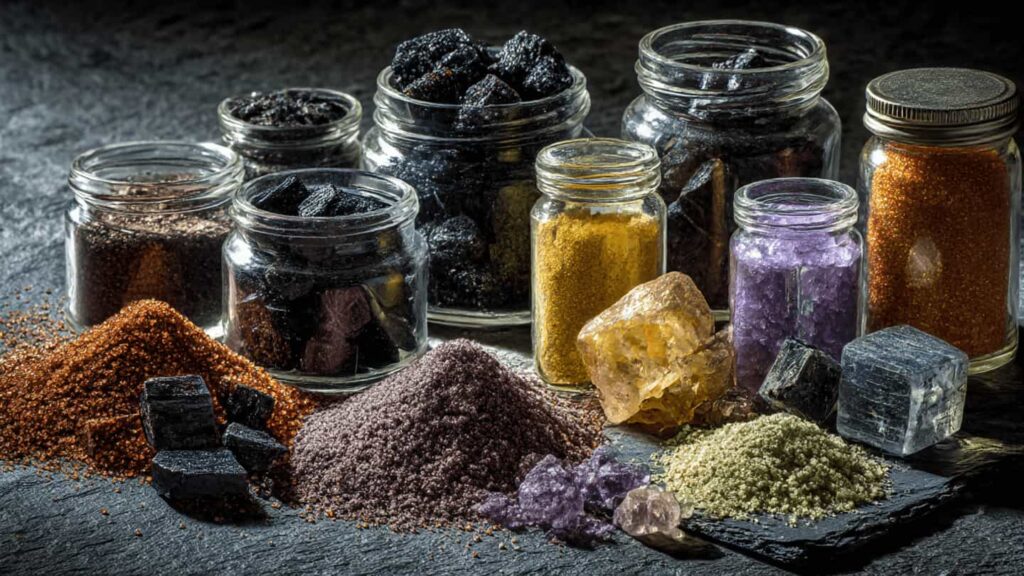
Despite their name, rare earth elements (REEs) are relatively abundant in the Earth’s crust. Their “rarity” comes from the fact they are rarely found in concentrated, economically exploitable deposits. They are often dispersed and mixed with other elements, making them challenging and environmentally intensive to mine and process.
The group consists of 17 metals: the 15 lanthanides on the periodic table, plus scandium and yttrium. These elements share similar chemical properties but have unique applications that make them indispensable.
The table below lists all 17 rare earth elements, categorized as Light (LREE) or Heavy (HREE), along with their primary applications.
| Element | Symbol | Category | Key Applications |
| Lanthanum | La | LREE | Battery alloys, camera lenses, hydrogen storage |
| Cerium | Ce | LREE | Catalytic converters, glass polishing, phosphors |
| Praseodymium | Pr | LREE | High-strength magnets, aircraft engines, ceramic colors |
| Neodymium | Nd | LREE | The most critical; strongest permanent magnets (EVs, wind turbines, headphones) |
| Promethium | Pm | LREE | Nuclear batteries, luminous paint |
| Samarium | Sm | LREE | Magnets, cancer treatment, neutron absorption |
| Europium | Eu | LREE | Red and blue phosphors for LEDs and TV/phone screens |
| Gadolinium | Gd | HREE | MRI contrast agents, neutron capture therapy |
| Terbium | Tb | HREE | Green phosphors, solid-state devices, magnetostrictive alloys |
| Dysprosium | Dy | HREE | Critical for magnets in EVs (heat resistance) |
| Holmium | Ho | HREE | Highest magnetic strength, nuclear control rods |
| Erbium | Er | HREE | Fiber optic cables, laser technology |
| Thulium | Tm | HREE | Portable X-ray machines, lasers |
| Ytterbium | Yb | HREE | Stainless steel, solar panels, lasers |
| Lutetium | Lu | HREE | PET scan detectors, refining petroleum |
| Scandium | Sc | HREE | Aerospace alloys, high-performance lights, solid oxide fuel cells |
| Yttrium | Y | HREE | Red phosphors for LED screens, cancer treatments, superalloys |
What makes them so special are their unique magnetic, luminescent, and electrochemical properties. These properties are essential for making devices smaller, more efficient, and more powerful.
Where Are Rare Earth Minerals Used? Everything.
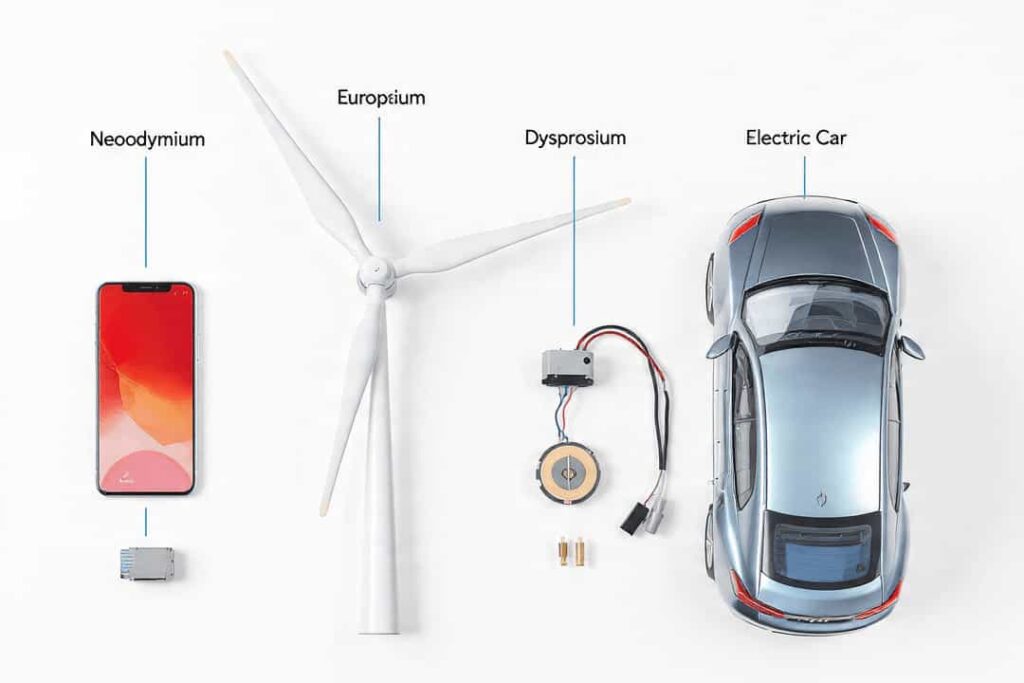
It’s easier to list industries that don’t use rare earths. Their applications are breathtakingly wide:
- Permanent Magnets: The single most important application. Neodymium-iron-boron (NdFeB) magnets are the strongest known permanent magnets. They are vital for:
- Electric Vehicles: Used in high-efficiency traction motors.
- Wind Turbines: Crucial for the generators in direct-drive turbines.
- Consumer Electronics: Found in the hard disk drives, speakers, and vibration motors of smartphones and laptops.
- Catalysts:
- Automotive: Cerium and Lanthanum are used in catalytic converters to reduce harmful emissions.
- Petroleum Refining: They are key catalysts in fluid catalytic cracking to produce gasoline.
- Phosphors and Lighting:
- Europium, Yttrium, and Terbium are used to create the red, blue, and green colors in LED screens, fluorescent lamps, and older cathode-ray tube displays.
- Defense and Aerospace:
- Used in precision-guided missiles, jet engines, radar systems, and sonar. Their lightweight and strong magnetic properties are indispensable for modern defense technology.
- Glass and Ceramics:
- Cerium is used for polishing glass, including the screens of smartphones and telescopes. It can also be used to decolorize glass.
- Metallurgy:
- Small amounts of rare earths are added to metals like aluminium and magnesium to improve their strength, workability, and heat resistance. For instance, they can enhance the properties of specific aluminium alloys used in high-stress applications. You can learn more about the foundational material in our guide, What is Aluminium and How is it Made?.
- Batteries:
- Lanthanum is a key component in nickel-metal hydride (NiMH) batteries, commonly used in some hybrid vehicles.
- Medical Technology:
- Used in MRI contrast agents, medical lasers, and portable X-ray machines.
As we advance into a greener future, the demand for these minerals is set to skyrocket. The very technologies driving the electric vehicle revolution, which relies heavily on aluminium for lightweighting, also depend on rare earth magnets. Discover aluminium’s role in this transformation in our article, Aluminium’s Crucial Impact on Transforming Vehicles into Next-Gen Intelligent Mobility.
The Dragon’s Hoard: Why China is the Undisputed Leader
China currently accounts for roughly 70% of global rare earth mining and a staggering 85-90% of the complex processing capacity. This dominance is not an accident but the result of a deliberate, long-term strategic play.
Global Rare Earth Mine Production (2024 Estimates)
| Rank | Country | Rare Earth Oxide (REO) Equivalent Production (Metric Tons) | Share of Global Total |
| 1 | China 🇨🇳 | 270,000 MT | 69.2% |
| 2 | United States 🇺🇸 | 45,000 MT | 11.5% |
| 3 | Myanmar (Burma) 🇲🇲 | 31,000 MT | 7.9% |
| 4 | Australia 🇦🇺 | 13,000 MT | 3.3% |
| 5 | Thailand 🇹🇭 | 13,000 MT | 3.3% |
| 6 | India 🇮🇳 | 2,900 MT | 0.7% |
Source: Based on USGS Mineral Commodity Summaries 2025
Historical Foresight and Investment: While the West focused on cheaper supplies in the late 20th century, China recognized the strategic value of rare earths. It invested heavily in mining and, most importantly, in the complex, costly, and polluting separation and processing technologies. This created a massive knowledge and infrastructure gap that other countries are still struggling to close.
Consolidated Supply Chain: China has vertically integrated its entire rare earth industry. From mining to separation, magnet production, and final product manufacturing (like EVs and wind turbines), everything happens within its borders. This creates immense efficiency and cost advantages that are hard to compete with.
Strategic Export Controls (New Reality): China has recently escalated its strategy by imposing strict export controls on equipment essential for separation and refining, and on a growing list of heavy rare earth elements (HREEs) and related compounds and magnets. This shifts its leverage from simply volume control to technology and capability control, specifically targeting high-value defense and EV supply chains globally.
Lower Environmental and Labor Costs: The process of separating rare earths involves toxic acids and produces radioactive waste. China was historically willing to bear these environmental costs, allowing for cheaper production compared to countries with stricter environmental regulations.
Geological Fortune: Simply put, China has large, concentrated deposits of both light and heavy rare earths, particularly the highly sought-after heavy rare earths, which are even less common globally.
The global push for sustainability and the aluminium industry’s drive for a greener footprint are directly linked to this supply chain. The solar energy sector, for example, which uses aluminium as a backbone, also relies on rare earths for certain high-efficiency technologies. Learn more in Solar Aluminium: The Unsung Hero.
The Global Response and Future Outlook
China’s dominance creates significant geopolitical and supply chain risks, as the world witnessed during the 2010 rare earth crisis and, more recently, with the 2025 export restrictions. In response, other nations are scrambling to diversify:
The U.S. Revival (Mountain Pass): The only operational U.S. mine, Mountain Pass in California (owned by MP Materials), has seen its annual production grow to approximately 45,000 MT. Crucially, it has rapidly restored its domestic facilities to process and refine Light Rare Earth Elements (LREEs) into high-purity oxides, significantly reducing its reliance on Chinese refining. It is now moving towards building a domestic magnet manufacturing facility to complete a fully integrated “mine-to-magnet” supply chain.
The Recycling Imperative: The European Union (EU), through initiatives like the Critical Raw Materials Act, is mandating that by 2030, at least 25% of its strategic mineral consumption must come from recycling. Projects like HARMONY (EU-funded) are developing closed-loop processes to recover NdFeB magnets from electric motors and wind turbines. Similarly, North American and Asian companies are investing heavily in new hydrogen-based magnet recycling technologies to create a fast, independent, and environmentally superior supply source (often termed “Urban Mining”).
New Primary Sources: Australia, Canada, and Brazil are increasing their mining activities, backed by government and private investment, to bring non-Chinese REE concentrate to the market. Major discoveries, like the Fen Complex in Norway, also offer potential long-term European supply.
However, building a separate, competitive supply chain from scratch will take billions of dollars and many years. The technical expertise for large-scale, economically viable processing, particularly for HREEs, largely remains locked in China.
For industries downstream, including the aluminium sector, this means volatility and a need for strategic planning. Understanding the entire value chain, from raw minerals to finished products, is more critical than ever. For a broader look at the industry’s dynamics, explore our analysis on Aluminium Tariffs and Price Trends.
Rare earth minerals are the linchpin of modern technology and the clean energy transition. While they are geologically “not so rare,” their economic and geopolitical concentration in China presents a unique challenge to the global economy. As the world wakes up to this reality, the race is on to develop alternative supplies, improve recycling, and foster international cooperation. For now, the path to a high-tech, green future runs directly through China, a reality that governments and industries must navigate with careful strategy and innovation.
External Sources for Further Knowledge:
- U.S. Geological Survey (USGS): Rare Earths Statistics and Information (Opens in a new tab)
- International Energy Agency (IEA): The Role of Critical Minerals in Clean Energy Transitions (Opens in a new tab)
- European Commission: Critical Raw Materials (Opens in a new tab)