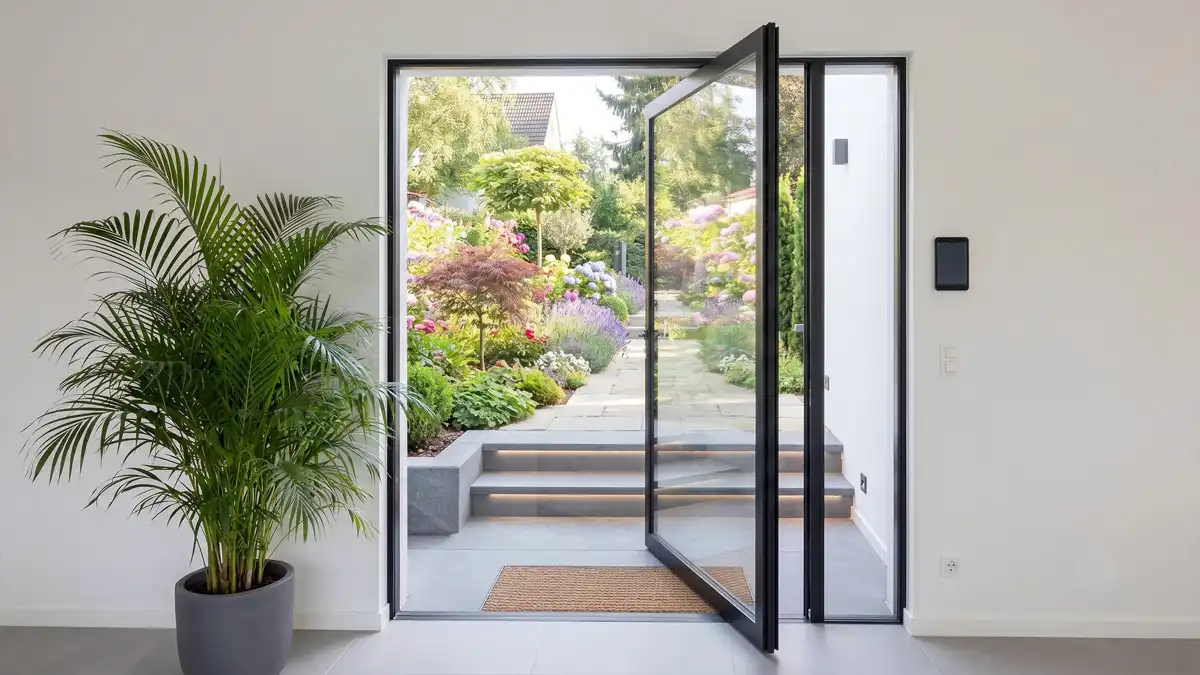
Pivot doors have become a defining feature in contemporary architecture. Their unique mechanism—rotating on a vertical axis at the top and bottom rather than swinging on side hinges—creates a dramatic, floating appearance that instantly elevates any space.
But here’s the truth that many homeowners overlook: a pivot door’s performance, cost, and suitability depend almost entirely on where you install it. A door that works beautifully as an interior room divider may be a costly mistake as a front entrance in a cold climate.
This guide breaks down pivot doors by installation location—ground floor front doors, patio doors, upper-floor doors, and interior doors—so you can make the right choice for your specific situation.
The Biggest Mistake Buyers Make
Many homeowners choose a pivot door because it looks impressive in photos. But the same door may perform very differently depending on whether it is installed as a front entrance, patio door, upper-floor door, or interior room divider.
Location often matters more than the door itself. A door designed for interior use lacks the sealing and thermal performance needed for exterior applications. Conversely, a thermally broken exterior pivot door is over-engineered and unnecessarily expensive for a home office partition. Understanding your installation location is the first—and most important—step in the selection process.
Why Location Matters More Than You Think
Before diving into each location, it’s worth understanding why installation context is so critical.
In general, pivot doors are more challenging to seal than traditional hinged doors because of their pivot mechanism and larger panel sizes. This is a non-issue for interior applications but becomes a major consideration for exterior doors where energy efficiency matters.
Additionally, pivot doors are larger, heavier, and more expensive than standard doors. They require precise installation—drilling into the floor and ceiling rather than simply anchoring a frame—and typically need professional installation.
With these fundamentals in mind, let’s examine each installation location.
1. Ground Floor Pivot Front Door (Main Entrance)
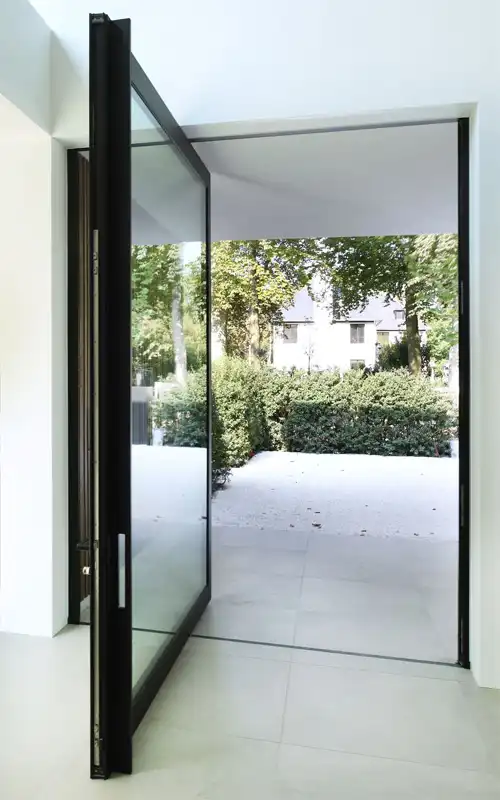
The front door is the most demanding installation location for any door type. It must provide security, weather protection, energy efficiency, and curb appeal—all while withstanding daily use.
✅ Advantages
- Dramatic First Impression: A pivot front door creates an unforgettable entrance. The smooth, floating motion and large panel size make a bold architectural statement that standard hinged doors simply cannot match.
- Oversized Panels Possible: Pivot hardware can support doors up to 1,500mm wide and 3,000mm tall—ideal for creating a grand entrance.
- Uninterrupted Views: Large glass pivot doors provide clear sightlines without mullions or bars.
⚠️ Disadvantages
- Energy Efficiency Challenges: Because pivot doors don’t seal as tightly as hinged doors, they can allow drafts and put more pressure on your HVAC system. In extreme climates, this can significantly increase energy costs.
- Thermal Break is Essential (and Expensive): For exterior doors, a thermal break system is non-negotiable. Thermal break technology separates interior and exterior aluminum components to reduce heat and cold transfer. This prevents condensation, improves insulation, and maintains consistent indoor temperatures. However, this adds significantly to the cost.
- Weather Resistance is More Complex: Pivot doors are generally less weather-resistant than high-quality hinged doors because they rely on more complex sealing systems. Poor installation or low-quality hardware can lead to air leakage, water ingress, or operational issues over time.
- Higher Cost: Front door pivot installations typically require expanding the opening, specialized hardware, and professional installation—all of which increase the total project cost.
- Maintenance Requirements: The top hinge can loosen over time, requiring professional adjustment. Regular lubrication is also necessary.
🏠 Climate Considerations
| Climate Factor | Impact | Solution |
|---|---|---|
| Hot / Humid | Heat transfer increases cooling costs; condensation risks | Thermal break frame + low-E glass |
| Cold / Snow | Heat loss increases heating costs; seal failure causes drafts | Thermal break + multi-point seals + double/triple glazing |
| Coastal | Salt corrosion damages unprotected aluminum | Marine-grade alloy + stainless steel hardware + powder coating |
| High Wind | Door flex and air leakage | Reinforced frame + high Wind Resistance Class rating |
💰 Cost Reality Check
A thermally broken pivot front door is a premium investment. The combination of custom sizing, thermal break technology, specialized hardware, and professional installation means you should expect to pay significantly more than a standard hinged front door.
Most homeowners choose pivot front doors for their architectural impact rather than long-term energy savings alone. For many, the aesthetic and functional benefits justify the expense for luxury projects—but this is not a budget-friendly choice.
2. Pivot Patio / Backyard Door
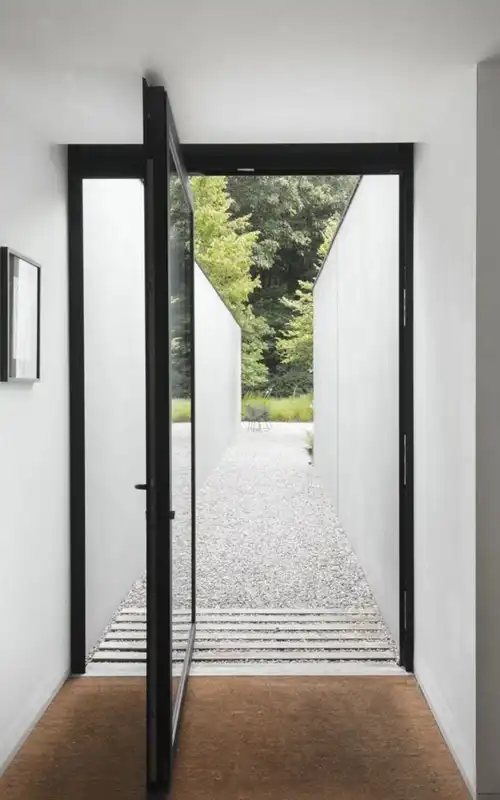
A sleek pivot patio door that maximizes garden views and creates a seamless transition between indoor and outdoor spaces.
Patio doors connect indoor living spaces to the outdoors, prioritizing light, view, and easy operation. A pivot patio door offers a compelling alternative to sliding or French doors.
✅ Advantages
- Seamless Indoor-Outdoor Transition: Most pivot doors are installed where internal and external floor levels are flush, creating a seamless transition between inside and out.
- Expansive Views: Like front doors, pivot patio doors can feature large, uninterrupted glass panels for unobstructed garden views.
- Smooth Operation: Even with large panels, well-designed pivot doors open with a gentle push.
- Luxury Aesthetic: A pivot patio door becomes a striking design feature that adds significant visual appeal.
⚠️ Disadvantages
- Same Airtightness Issues: As an exterior door, patio pivot doors face the same sealing challenges as front doors. They don’t seal as tightly as hinged doors.
- Drainage Requirements: Flush floor installation requires robust drainage solutions such as slot drains.
- Swing Clearance Needed: Pivot doors require space on both the inside and outside to swing open. This can be problematic in tight patio areas.
- Weather Exposure: Patio doors often face direct weather exposure—rain, sun, wind—which accelerates wear on seals and hardware.
🏠 Climate Considerations
| Climate Factor | Impact | Solution |
|---|---|---|
| Hot / Humid | Solar heat gain through glass; moisture intrusion | Low-E glass + thermal break + proper drainage |
| Cold | Heat loss through glass and frame gaps | Double/triple glazing + thermal break + compression seals |
| Rain-Prone | Water ingress at threshold | Slot drainage + weatherstripping + sloped sill |
| Coastal | Salt spray corrosion | Marine-grade aluminum + stainless steel hardware |
💰 Cost Reality Check
A pivot patio door typically costs less than a pivot front door because it may not require the same level of security hardware or thermal performance. However, if your patio door faces extreme weather or you want year-round comfort, investing in thermal break technology is still advisable. The cost is generally higher than sliding doors but comparable to high-end French doors.
3. Upper Floor Doors (Balcony / Terrace)
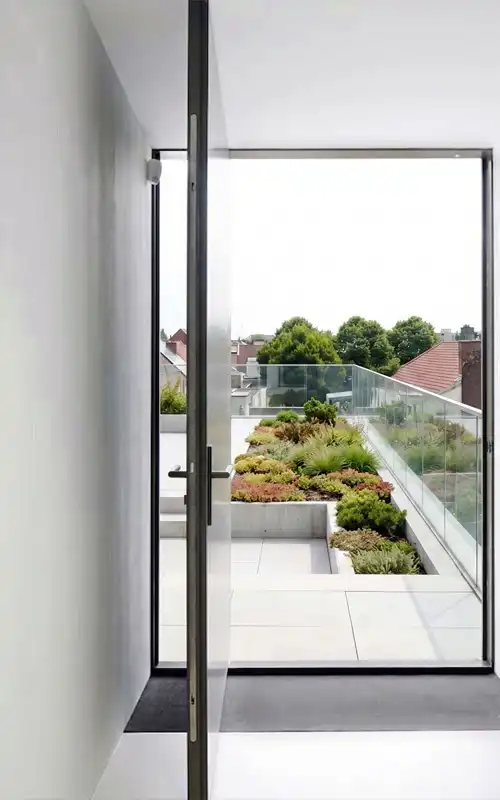
Upper-floor doors—whether leading to a balcony, terrace, or rooftop—present unique challenges related to wind exposure, safety, and accessibility.
✅ Advantages
- Stunning Views: An upper-floor pivot door can frame panoramic views beautifully, especially with large glass panels.
- Space-Saving: In tight upper-floor layouts, a pivot door can be more space-efficient than a swinging door because the swing arc is divided between inside and outside.
- Design Statement: Even in upper floors, a pivot door adds a touch of luxury and modernity.
⚠️ Disadvantages
- Wind Exposure: Upper floors experience higher wind loads. Pivot doors, with their larger panels, can catch wind and swing violently—posing safety risks.
- Installation Complexity: Installing a pivot door on an upper floor is more challenging and potentially more dangerous, requiring careful planning and professional expertise.
- Weight Considerations: The floor structure must support the door’s weight. Upper floors may require reinforcement.
- Safety Concerns: Large glass panels at height create fall risks if glass breaks. Tempered or laminated safety glass is mandatory.
- Accessibility: Getting materials and hardware to upper floors adds to installation costs.
🏠 Climate Considerations
| Climate Factor | Impact | Solution |
|---|---|---|
| High Wind | Door can swing violently; seal failure | Wind-resistant hardware + reinforced frame + hold-open stops |
| Cold | Heat loss; condensation | Thermal break + insulated glass |
| Hot | Solar heat gain through glass | Low-E glass + thermal break |
| Rain | Water ingress at threshold | Weatherstripping + drainage |
💰 Cost Reality Check
Upper-floor pivot doors often cost more than ground-floor installations due to increased installation complexity and the need for wind-resistant hardware. Safety glass is mandatory, adding to the cost. If the upper floor is exposed to extreme weather, thermal break technology becomes essential.
4. Pivot Interior Doors (Room Dividers / Home Offices / Closets)
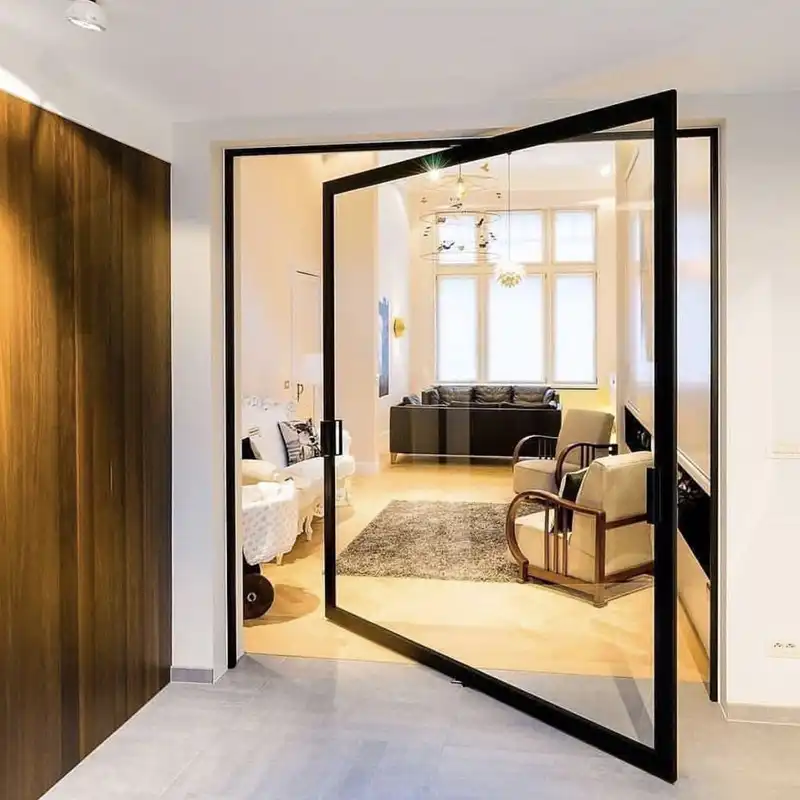
Interior pivot doors are where the design truly shines without the performance compromises of exterior installations.
✅ Advantages
- Dramatic Design Feature: A pivot door as a room divider or home office entrance creates a stunning focal point.
- Space-Saving: In tight spaces, a pivot door can be a good solution because the swing width is split between two spaces.
- Smooth, Effortless Operation: Even large interior pivot doors open with a gentle push.
- Sound Insulation: When made with dense materials like solid wood, pivot doors can block out noise effectively.
- Flexible Materials: Pivot hinges can handle glass, metal, solid wood, or even marble.
- No Airtightness Concerns: Interior doors don’t need to be weather-sealed, so the pivot door’s primary disadvantage (less airtightness) is irrelevant.
⚠️ Disadvantages
- Higher Cost Than Standard Interior Doors: Even for interior use, pivot doors are more expensive than standard hinged doors.
- May Not Suit Small Spaces: While space-saving in some ways, pivot doors still require swing clearance and may not be suitable for very tight areas.
- Installation Complexity: Requires precision drilling into floor and ceiling.
- Pinch Risk: The pivot mechanism creates potential pinch points—a concern in homes with young children.
🏠 Climate Considerations
| Factor | Impact | Solution |
|---|---|---|
| Humidity (Bathrooms/Kitchens) | Moisture can affect wood or MDF doors | Choose aluminum or moisture-resistant materials |
| Temperature Fluctuations | Some materials expand/contract | Choose stable materials like aluminum |
| Acoustics | Sound transfer between rooms | Solid core or dense materials for sound insulation |
💰 Cost Reality Check
Interior pivot doors are the most cost-effective pivot door option because they don’t require thermal break technology, weather sealing, or security hardware. However, they still cost more than standard interior doors. The investment is typically justified by the dramatic design impact rather than functional necessity.
Decision Matrix: Which Location Is Right for You?
| Installation Location | Best For | Key Concerns | Thermal Break Needed? | Cost Level |
|---|---|---|---|---|
| Ground Floor Front Door | Luxury homes making a statement | Energy efficiency, weather resistance, security | Yes (essential) | Very High |
| Patio / Backyard Door | Indoor-outdoor living spaces | Weather exposure, drainage, swing clearance | Recommended (if extreme climate) | High |
| Upper Floor Door | Balconies with views | Wind, safety, installation complexity | Recommended (if exposed) | High-Medium |
| Interior Door | Room dividers, home offices, design features | Space, pinch risk, aesthetics | No | Medium |
Final Verdict
Pivot doors are not a one-size-fits-all solution. Their suitability depends heavily on where you install them:
- For ground floor front doors: Only proceed if you’re willing to invest in thermal break technology and accept higher energy costs and maintenance. The dramatic entrance is worth it for luxury projects, but not for budget-conscious homeowners.
- For patio doors: A pivot patio door offers stunning views and seamless indoor-outdoor living—but requires proper drainage and swing clearance. Thermal break is recommended in extreme climates.
- For upper-floor doors: Wind resistance and safety are paramount. Professional installation is non-negotiable.
- For interior doors: This is where pivot doors truly excel with minimal compromises. If you want the pivot door aesthetic without the performance headaches, install it indoors.
Explore our design gallery of modern pivot doors for inspiration, and compare aluminium swing doors vs pivot doors to make the best choice for your home.
Related Articles
Featured



You May Also Like

Aluminum Industry’s Hidden Treasures: Profitable Niche…

Discover the Best UK Regions for Aluminium Windows Based on …
Top 9 Tips for Aluminum Sliding Door Treatment

Aluminium Outdoor Umbrella Business: The Complete Guide

Aluminium Borate (AlBO₃): The Complete Guide